
-
 featured
Sep 8 - Sep 8, 2027
Tuition
$2,708
Scholarships available
- featured
Jan 4 - Jan 4, 2029
Tuition
$5,416
Scholarships available
- featured
Sep 8 - Sep 8, 2028
Tuition
$5,416
Scholarships available
-
 featured
Online
Sep 1 - Sep 1, 2027
Tuition
$5,442
Scholarships available
- featured
Sep 8 - Sep 8, 2028
Tuition
$5,442
Scholarships available
- featured
- featured


About
 Engineers are the problem-solvers who turn big ideas into real-world solutions—whether that’s building cleaner energy systems, designing safer medical devices, or coding the next iteration of AI.
Studying engineering is about much more than crunching numbers: An engineering program will challenge you to think critically, collaborate with diverse teams, and bring creativity to technical challenges. You’ll dive deep into math, physics, and materials science, but you’ll also hone practical skills in design, testing, and project management.
The most common starting point is a Bachelor of Engineering (BEng or BASc), which typically involves four years of study (or five with a co-op). During those programs, students can choose from dozens of specializations: civil, mechanical, electrical, chemical, biomedical, software, environmental, aerospace, and more. The best engineering schools in Canada will have extensive hands-on learning opportunities, including in-class labs as well as co-ops and work placements that prepare students for the job market upon graduation. Many graduates continue on to master’s programs to further specialize, while others jump straight into the workforce where demand is strong across industries like construction, energy, manufacturing, and technology.
Engineers are in demand across Canada, as we look to fill the gaps created by retirements and continued economic growth across industries. Infrastructure projects, sustainability initiatives, digital transformation, and new technologies mean Canadian employers are competing for engineering talent across nearly every discipline—with the strongest demand in disciplines such as structural, civil and mechanical engineering, where there are growing labour shortages (as opposed to technological, computer, and software engineering, where supply and demand are more balanced).
For graduates, that translates into choice: you can design skyscrapers, optimize supply chains, or invent products that haven’t been dreamed up yet. Those just starting out will typically earn salaries between $80,000-90,000, with more established engineers earning upwards of $120,000 a year.
Frequently Asked Questions (FAQ)
What are the entry requirements for an engineering degree in Canada?
Most engineering programs in Canada require strong overall grades in high school including advanced math, physics, and chemistry. Some universities may also ask for calculus, and computer science, as well as supplementary applications like personal statements and references.
Even if a school doesn’t publish a strict “GPA cutoff,” the typical entering averages for many top programs are very high (often mid-80s to mid-90s percentages among Canadian high-school applicants).
McMaster University and University of Calgary, for example, tend to see minimums around the mid-80s, while the highest ranking engineering schools including University of Toronto and McGill University regularly have cut-offs in the low-to-mid-90s. Interestingly, University of Waterloo explicitly refuses to set an “absolute grade cut-off” because admissions vary greatly depending on applicant pool and supplementary materials.
Given how competitive admission can be at the best engineering schools in Canada, strong academics and extracurricular achievements can make your application stand out.
International students also usually need proof of English or French language proficiency.
How long does it take to complete an engineering degree?
A bachelor’s degree in engineering typically takes four years of full-time study in Canada, not including co-op placements. Programs with full year co-op placements typically extend your degree to five years—though it’s not uncommon for engineering students to take an additional year or so if they enroll in additional placements for more work experience throughout their studies.
Do I need to be licensed to work as an engineer in Canada?
Yes, if you want to call yourself an engineer and take responsibility for engineering projects, you must be licensed by your provincial or territorial engineering regulator. To get licensed as a Professional Engineer (what’s called getting your P.Eng), you’ll need an accredited engineering degree, several years of supervised work experience (usually four), and to pass a professional practice exam. Many graduates begin as Engineers-in-Training (EITs) while they work toward full licensure. See the Certification and Licensing section for more information.
What kinds of engineering can I specialize in?
Canadian universities offer dozens of engineering specializations, ranging from well-known fields like civil, mechanical, and electrical engineering to niche areas such as aerospace, biomedical, and environmental engineering. Your choice depends on your interests—whether that’s designing bridges, developing clean energy solutions, or building spacecraft. Specializing can help you target industries with strong demand, but many engineers also build cross-disciplinary skills to stay flexible. You can learn more about the unique specializations on offer at the best engineering schools in Canada in our ranking.
How much do engineers earn in Canada?
The average salary for an entry-level engineer in Canada is between $80,000 and $90,000, with established engineers typically earning about $120,000 annually based on data collected from Talent.com, Indeed, Glassdoor and Canada’s Job Bank. See the Careers and Salaries sections for more details on average earnings across distinct engineering specialties.
Certification & Licensing
Your path to becoming an engineer in Canada unfolds in stages. It starts with a Bachelor’s degree, typically either a Bachelor of Engineering (BEng) or a Bachelor of Applied Science (BASc). Admission requires strong grades in high school math and sciences, but the top engineering schools in Canada may also look for extracurriculars that demonstrate problem-solving, teamwork, or innovation.
After graduation, you can register as an Engineer-in-Training with your provincial regulator (see the list below). This allows you to gain supervised work experience while moving toward full licensure, which is the Professional Engineer title, or P.Eng. According to Engineers Canada, to earn the P.Eng., you’ll need a degree from a Canadian Engineering Accreditation Board-accredited undergraduate program, about four years of approved work experience, references from licensed engineers that indicate good character, and to pass the Professional Practice Examination (PPE). You also need to prove that you are competent in one of Canada’s two official languages, English and French. The P.Eng credential gives you the legal authority to call yourself an engineer and take responsibility for engineering projects.
If you earned your engineering degree outside Canada, your academic credentials must be assessed by the provincial regulator. In most cases, you’ll be asked to submit transcripts and detailed course descriptions for evaluation, and you may need to complete confirmatory exams or additional courses to demonstrate equivalency with a CEAB-accredited program.
Canada’s provincial and territorial engineering regulators are:
- Engineers and Geoscientists British Columbia
- Association of Professional Engineers and Geoscientists of Alberta (APEGA)
- Engineers Geoscientists Manitoba
- Professional Engineers Ontario (PEO)
- Engineers and Geoscientists New Brunswick
- Association of Professional Engineers and Geoscientists of Saskatchewan (APEGS)
- Engineers Nova Scotia
- Engineers PEI
- Engineers Yukon
- Northwest Territories and Nunavut Association of Professional Engineers and Geoscientists (NAPEG)
- Ordre des ingénieurs du Québec (OIQ)
- Professional Engineers and Geoscientists of Newfoundland and Labrador (PEGNL)
On top of licensing, many engineers pursue a master’s degree or PhD to specialize in fields like renewable energy, robotics, biomedical engineering, or nanotechnology. These advanced degrees open doors to leadership roles, research, and academia.
Employers increasingly look for engineers with complementary skills: think project management (PMP certification), software and coding expertise, or specialized design tools like AutoCAD and SolidWorks. Training in sustainability, data science, or business management (including earning an MBA) can also set candidates apart, especially as engineering teams take on more complex, interdisciplinary projects.
Electrical Engineering Technology (Fast-Track) program provides a shorter duration pathway for both international and domestic trained Electrical Technicians/Technologists and other related programs to have previous work experience and/or degree credentials assessed to prevent an unnecessary repeat of courses. Rapid changes … Continue reading
Humber’s Mechanical Engineering Technology is an advanced diploma program that provides you with hands-on experience and the underlying foundational knowledge required to conceive, design, manufacture and operate engineering systems. Working on projects in state-of-the-art laboratories and design spaces, you will … Continue reading
Mohawk College’s Civil Engineering Technician program offers students a comprehensive foundation in planning, design, surveying, material science, and construction across a variety of engineering industries. With a strong focus on project management, Civil 3D software, and municipal services, students gain … Continue reading

Manage electrical energy — from both renewable and conventional sources — as an electrical engineer with training in power systems, electrical design and control and automation. Get wired for a bright future. The Electrical Engineering Technology program offers comprehensive training … Continue reading
Centennial College’s Biomedical Engineering Technology program has been designed to meet the need for qualified professionals caused by the merger between the biomedical equipment industry and the engineering and scientific disciplines. These collaborations have created beneficial innovations for both health … Continue reading
Humber’s Bachelor of Engineering program begins with a foundational first year that provides students with essential engineering knowledge and skills. After the first year, the curriculum branches into three distinct discipline areas: Information Systems Engineering, Mechatronics Engineering, and Sustainable Building … Continue reading
Tuition & Completion Data
Domestic

Last updated: April 19, 2026
International
See below for the latest data on international student tuition across Canada, excluding housing costs and ancillary fees.
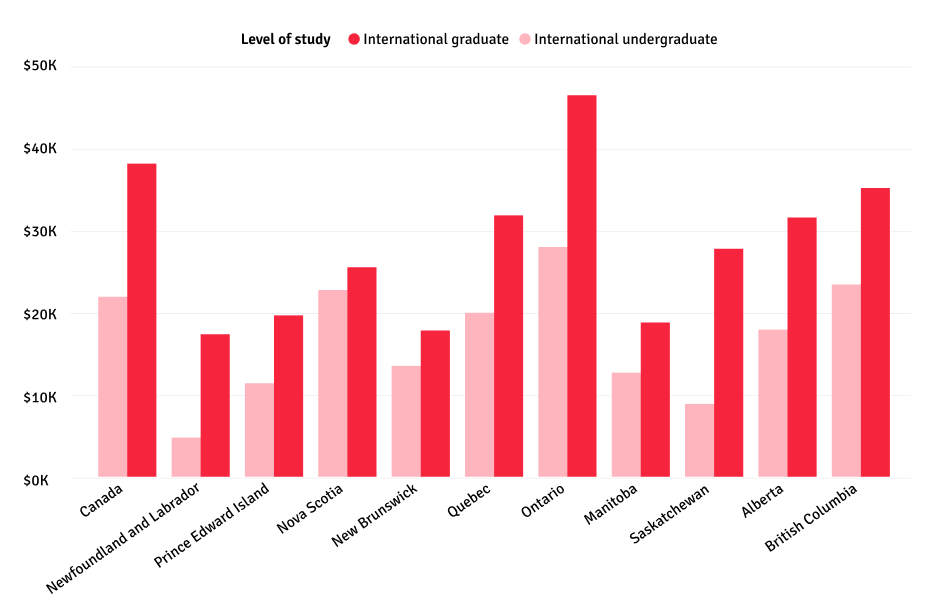
Source: Statistics Canada 2023
Careers
With many senior engineers approaching retirement and industries on growth trajectories, a wave of job openings is expected to open up over the next decade. This demand for more experienced talent will in turn create more opportunities for entry-level engineering graduates.
Demand varies based on what kind of engineer you are. According to Canada’s Job Bank, for example, power generation engineers face a moderate risk of labour shortage nationally for 2024–2033, reflecting growing demand and turnover. Electrical and electronics engineers are seeing the same shortages, as are mechanical engineers: The Canadian Occupational Projection System (COPS) found that mechanical engineers will only see modest job creation (annual growth of just 0.7 percent) over 2024–2033, but replacement demand due to retirements will account for nearly three-quarters (73 percent) of openings.
The pressure is greatest in structural, civil, and mechanical disciplines, where labour supply is tighter. In contrast, fields like computing, software, or technology-heavy engineering are seeing more balance between supply and demand from 2024–2033.
Here’s a look at potential engineering careers in Canada, across seniority and specialization:
Junior Engineer / Engineer in Training – $62,000 – $74,000
Entry-level engineers support design, testing, and analysis under supervision while gaining the experience required to earn a P.Eng. designation. It’s a role built for learning, mentorship, and hands-on exposure to real projects.
Engineering Coordinator – $80,000 – $90,000
Engineering coordinators keep projects on track by managing timelines, budgets, and communication between technical teams and stakeholders. They balance organizational skills with a solid understanding of engineering processes.
Mechanical Engineer – $80,000 – $115,000
Mechanical engineers bring machines to life, from industrial robotics and vehicles to energy systems and manufacturing equipment. Their work blends physics, creativity, and technical problem-solving.
Industrial Engineer / Systems Engineer – $80,000 – $115,000
Industrial and systems engineers improve efficiency by optimizing complex systems—like supply chains, manufacturing lines, and logistics networks. They’re experts at making large operations run smarter, faster, and safer.
Environmental Engineer – $80,000 – $115,000
Environmental engineers create solutions to protect natural resources and public health, such as designing clean water systems, waste treatment facilities, and renewable energy projects, with a focus on sustainability and long-term impact.
Aerospace Engineers – $80,000 – $115,000
Aerospace engineers design, test, and improve aircraft, spacecraft, and satellites, ensuring safe air travel pushing the boundaries of aviation and space exploration.
Project / Construction Engineer – $80,000 – $115,000
Project and construction engineers oversee engineering projects from planning through execution, coordinating technical design with on-the-ground construction.
Software Engineer / Computer Engineer – $80,000 – $115,000
These engineers design and integrate hardware and software systems, developing everything from embedded chips to large-scale computing infrastructure. They often bridge the gap between engineering and computer science.
Electrical / Electronics Engineer – $90,000 – $115,000
Electrical engineers develop the systems that power our homes, industries, and digital devices, from renewable energy grids to communications hardware.
Civil Engineer / Structural Engineer – $90,000 – $115,000
Civil and structural engineers design, build, and maintain the infrastructure that keeps communities running—roads, bridges, buildings, and water systems. They prioritize safety, durability, and sustainability in every project.
Engineering Manager – $117,000 – $169,000
Engineering managers lead teams, allocate resources, and set technical strategy. They move between high-level planning and people leadership, ensuring projects align with business goals.
Principal Engineer – $126,000 – $176,000
Principal engineers are technical leaders with deep expertise who guide innovation, set design standards, and mentor teams. They often influence an organization’s long-term engineering direction.
Salaries
The average salary for an entry-level engineer in Canada is between $80,000 and $90,000, with established engineers typically earning about $120,000 annually based on data collected from Talent.com, Indeed, Glassdoor and Canada’s Job Bank. Here is a closer look at salary ranges based on job type and seniority:
| Role | Average Salary in Canada |
|---|---|
| Junior Engineer / Engineer in Training | $71,685 |
| Engineering Coordinator | $83,635 |
| Industrial Engineer / Systems Engineer | $83,687 |
| Mechanical Engineer | $87,435 |
| Environmental Engineer | $89,331 |
| Aerospace Engineer | $89,453 |
| Electrical / Electronics Engineer | $91,270 |
| Project / Construction Engineer | $92,744 |
| Civil Engineer / Structural Engineer | $93,617 |
| Software Engineer / Computer Engineer | $101,822 |
| Engineering Manager | $141,915 |
| Principal Engineer | $149,000 |