
-
 featured
 -
 featured
Sep 8 - Sep 8, 2029
Tuition
$8,163
Scholarships available
- featured
Sep 8 - Sep 8, 2029
Tuition
$11,690
Scholarships available
- featured
Sep 8 - Sep 8, 2028
Tuition
$35,560
Scholarships available
- featured
Sep 8 - Sep 8, 2029
Tuition
$56,610
Scholarships available
-

Sep 8 - Sep 8, 2028
Tuition
$2,696
Scholarships available
-


About
 Biomedical Science degrees prepare students for a future in medicine and related sciences; graduates might continue on to advanced degree programs, or head directly into careers in fields such as biotechnology. Typically some of the best pre-med programs in Canada, biomed sci graduates are well-prepared to write the MCAT and apply to medical school, with comprehensive preparation for what lies ahead.
Core courses that make up a biomedical science degree include biology, psychology, molecular biology, chemistry, organic chemistry, genetics, biostatistics, anatomy, physiology, and emerging health technologies.
Throughout a biomedical science program, students will develop essential laboratory skills, learning techniques like microscopy, which is critical for work in research labs. Additionally, the curriculum fosters strong analytical skills, enabling students to interpret and analyze complex biological data, as well as critical thinking abilities, guiding students to evaluate hypotheses, design experiments, and solve problems based on evidence.
Graduates of biomedical sciences programs can pursue a wide range of careers in fields such as medicine, dentistry, pharmacy, public health, secondary school teaching, and veterinary medicine. (Explore what else you can do with a biomedical sciences degree here.) Entry-level salaries for these roles tend to be between $70,000-$80,000 annually.
FAQ
What can I do with a biomedical science degree?
This degree is a great stepping stone to a wide range of opportunities. Known to be one of the best pre-med programs, biomedical science serves as a great basis for students seeking higher education including medical school, but also graduate programs in various biological sciences. Graduates entering the workforce may head toward the field of healthcare, taking on roles as clinical scientists, laboratory technicians, or public health professionals. Others pursue careers in the pharmaceutical and biotechnology industries, where they help develop new drugs and medical devices.
Read this article for more on what you can do with a biomedical sciences degree.
Is biomedical science a good degree?
Biomedical science is a great degree because it offers both scientific knowledge and practical application. With this degree, you’ll dive into a vibrant field that brings together human biology, health, and disease. Backed by a solid foundation in anatomy, physiology, math, and bioinformatics, you’ll get to apply your knowledge and skills in exciting research opportunities.
How long does it take to get a biomedical science degree?
To earn a Honours Bachelor of Science – Biomedical Sciences degree it will take students 48 months, which is equivalent to four years of full-time study.
Certification
A Biomedical Science program will typically grant you a Honours Bachelor of Science degree, which is often a stepping stone for students pursuing careers in medicine. Graduates of a biomedical science program will likely go on to higher education, such as medical school, the Masters/PhD track of academic study, or toward registered certifications which license graduates for certain career opportunities.
Possible post-graduate certifications can include clinical laboratory scientist, medical technologist, or specialized credentials in fields such as molecular diagnostics, public health, or genetic counseling. These study paths lend themselves to research and lab-based careers.
A related path of study is the Biomedical Engineering Technology diploma program, offered at colleges across the country, which prepares students to help develop and maintain the specialized medical equipment used to support patient care. These diplomas are typically two-year programs, as opposed to the four-year degrees, with direct paths to employment post-grad.

The Honours Bachelor of Science in Biomedical Sciences program provides an integrated, comprehensive curriculum to prepare graduates for medical school, graduate degree programs, and careers in biotechnology and related industries. The program focuses on developing knowledge and competencies in biomedical … Continue reading
Sep 1 - Sep 1, 2030
Tuition
$32,040
Scholarships available
Tuition
$32,040
Scholarships available

Biomedical science is a growing interdisciplinary field which supports the creation, revision and implementation of innovative methods to advance medicine and human health. Biomedical scientists integrate knowledge from numerous fields of study such as biology, chemistry, anatomy, physiology and pathophysiology, … Continue reading
Centennial College’s Biomedical Engineering Technology program has been designed to meet the need for qualified professionals caused by the merger between the biomedical equipment industry and the engineering and scientific disciplines. These collaborations have created beneficial innovations for both health … Continue reading
The Biotechnology program at Mohawk College provides students with a comprehensive foundation in the rapidly evolving field of biotechnology. This program explores key areas such as agricultural biotechnology, medical biotechnology, and biomanufacturing, equipping graduates with the skills necessary for careers … Continue reading

In Toronto Metropolitan University’s Biomedical Sciences – BSc (Hons) program, students will gain theoretical and practical expertise in the cellular and molecular sciences, with opportunities to conduct research into medically relevant concerns such as how cells turn cancerous and how … Continue reading

Fusing McMaster’s top-rated health sciences and engineering programs into a unique, problem-based learning experience. iBioMed students graduate ready to develop biomedical engineering solutions for real-world healthcare problems. iBioMed students work in state-of-the-art laboratories to learn the foundations of engineering, health … Continue reading
Tuition & Completion Data
Domestic
Below are CourseCompare’s real-time tuition calculations based on hundreds of programs and courses across Canada. These exclude ancillary fees (fees for on-campus services, textbooks, athletics, insurance and more).

Last updated: February 20, 2026
International
See below for the latest data on international student tuition across Canada, excluding housing costs and ancillary fees.
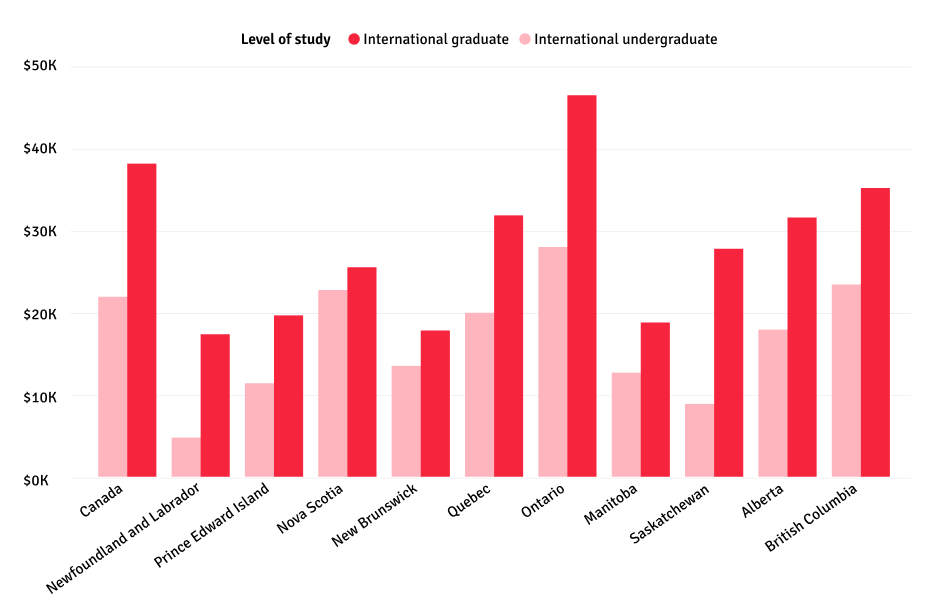
Source: Statistics Canada 2023
Careers
Job prospects for biomedical science graduates in Canada are promising: Over the 2022–2031 period, around 11,500 new job openings are expected for life science professionals, including biologists and related scientists, while even entry level roles like medical laboratory technicians have good growth prospects, according to Canada’s Job Bank. This growth is driven by both expansion in industries like biotechnology and the need for replacements due to retirements, leading to a wide range of career opportunities:
Laboratory Technician – $55,133
As a lab technician, you’ll be conducting tests on new products and experimental processes. You’ll execute lab tests with precision, adhering to established procedures. Your role also involves operating, cleaning, and maintaining a range of equipment, as well as handling and storing chemicals and materials, contributing to the overall efficiency and safety of the lab environment.
Microbiologist – $66,468
A microbiologist typically works in research, healthcare, or industry, studying how microorganisms impact human health. You may conduct medical research, develop treatments or vaccines, analyze patient samples to diagnose infections, or work in public health and biotechnology to prevent disease outbreaks and ensure safety in food production.
Scientific Writer – $72,355
Scientific writers are experts who craft articles to convey complex scientific concepts and findings to the public in ways that are easier to understand. You’ll blend research and writing skills to translate scientific terms into accessible language, often linking these concepts to current events to create engaging and informative content.
Biomedical Engineer – $78,587
A biomedical engineer designs and develops medical devices, equipment, and technologies that improve healthcare. You could create prosthetics, medical imaging systems, or artificial organs, as well as develop software for medical diagnostics.
Public Health Analyst – $79,258
A public health analyst gathers and interprets data to improve public health outcomes. In this role, you’ll deliver education and information to the public, community organizations, institutions, and government agencies. You’ll contribute to developing solutions, sharing health insights, and engaging with policymakers, the media, and the public.
Research Scientist – $82,577
Research scientists conduct experiments, analyze data, and interpret results in laboratories, universities, or research institutions and can specialize in areas such as biology, chemistry, medicine, or environmental science. Your work often contributes to scientific advancements, the development of new technologies, and solutions to complex problems.
Pharmaceutical Sales Representative – $92,500
A pharmaceutical sales representative is a skilled professional who influences healthcare providers by showcasing the benefits of your company’s drugs, treatments, and devices, demonstrating how these solutions excel in meeting patient needs.
Clinical Director – $109,546
The clinical director is a senior healthcare professional responsible for overseeing the daily operations of a medical department or clinic. They manage clinical staff, ensure the quality of patient care, and maintain regulatory compliance. Additionally, clinical directors develop and implement policies, coordinate clinical programs, and often play a key role in budgeting and strategic planning within healthcare facilities.
Read more about what you can do with a biomedical sciences degree here.
Salaries
With so many potential career paths ahead of biomedical science graduates, average salaries vary greatly based on the direction you take. Starting salaries for a lab technician, for example, average $55,133 annually, based on data collected from Indeed, Talent.com, Glassdoor and Canada’s Job Bank – but a more senior research scientist might earn $82,577 each year. Here is a closer look at salary ranges based on job type and seniority:
| Role | Average Salary in Canada |
|---|---|
| Laboratory Technician | $55,133 |
| Microbiologist | $66,468 |
| Scientific Writer | $72,355 |
| Biomedical Engineer | $78,587 |
| Public Health Analyst | $79,258 |
| Research Scientist | $82,577 |
| Pharmaceutical Sales Representative | $92,500 |
| Clinical Director | $109,546 |