
-
 featured
 - featured
Tuition
$5,514
-
 featured
Online
Nov 9 - Aug 13, 2027
Tuition
$11,580
Scholarships available
- featured
- featured
Online
Nov 9 - Dec 3, 2027
Tuition
$15,681
Scholarships available
-
 featured
Tuition
$17,505
Scholarships available
-
 featured
Tuition
$50,470
Scholarships available


About
 Mental health challenges affect millions of Canadians each year—and the country’s need for qualified counsellors is growing fast. From hospitals and schools to private practices and community organizations, mental health support is in demand across nearly every sector.
Counselling is a deeply human profession—one that empowers people to navigate life’s challenges and lead healthier, more fulfilling lives. Whether it’s supporting individuals through trauma, guiding career transitions, or strengthening emotional well-being, counsellors play an essential role in Canada’s healthcare and human services systems.
While responsibilities vary across roles, counsellors share a common purpose: to help others heal, grow, and thrive. Strong communication, empathy, and active listening are must-have skills in this field, along with the ability to support decision-making and crisis management.
To become a certified counsellor or registered psychotherapist in Canada, most professionals complete a graduate-level program and pursue certification through the Canadian Counselling and Psychotherapy Association (CCPA) or a provincial regulatory body. Colleges and universities across the country offer a range of counselling programs—from short-term certificates to full master’s degrees—designed to prepare candidates for this important work.
According to the Canadian Occupational Projection System (COPS), over the next decade there will be approximately 33,300 job openings for counsellors, with a moderate risk of shortage—indicating strong employment prospects for counsellors just getting started. Salaries vary depending on your specialization and setting, but the average income for certified counsellors and registered psychotherapists is around $67,600 per year, with experienced professionals earning up to $94,000 or more.
Frequently Asked Questions (FAQ)
What is the highest paid counselling job?
Among counselling professionals, psychologists tend to earn the highest salaries. This is largely due to the advanced education and licensing requirements—most psychologists in Canada must hold a PhD.
However, there are lots of opportunities to leverage other counselling education. Those who hold a Master’s of Counselling Psychology, for example, can become a Canadian Certified Counsellor registered with the CCPA upon meeting the education and clinical placement requirements. Other practitioners, such as registered nurses, can take counselling courses to enhance their expertise in specialized fields like trauma recovery, and become RN-Psychotherapists.
Can I become a counsellor without a master's degree?
Some counselling-related roles—such as mental health support workers or addictions workers—do not require a graduate degree, instead sufficing to have a relevant certificate or diploma. However, becoming a certified counsellor or psychotherapist in Canada typically requires at least a master’s degree, along with supervised clinical experience and registration with a regulatory body.
What else can I do with a counselling degree, diploma, or certificate?
A background in counselling opens doors beyond traditional therapy settings. Graduates often pursue careers in school counselling, addiction support, rehabilitation, human resources, corporate wellness, coaching, and more. The interpersonal and problem-solving skills developed in counselling programs are valuable across many people-focused professions.
Can I study counselling online in Canada?
Yes, many colleges and universities across Canada offer online or hybrid counselling programs, across the certificate, diploma, and degree levels.
The Becoming Institute, for example, offers an Introduction to Psychotherapy certificate live online, while its Trauma Recovery certificate and RN-Psychotherapist credentialing program are both hybrid. Yorkville University created the first online counsellor education degree in Canada (ranked one of the best master’s of counselling psychology programs in Canada).
Graduate degrees in counselling may also offer part-time and remote options designed for working professionals, though in-person practicum placements are still required.
How long does it take to become a certified counsellor in Canada?
Most certified counsellors spend between six and eight years completing their undergraduate and graduate education, including supervised clinical training. Additional time may be needed to meet certification or provincial licensure requirements, depending on your path and location.
Are counsellors in demand in Canada?
Yes, counsellors and related professionals remain in steady demand; in fact, there’s a moderate shortage of talent predicted over the next ten years. As awareness of mental health continues to grow, so does the need for qualified professionals in schools, clinics, community agencies, and private practice. According to the Canada Job Bank, there will be approximately 33,300 job openings between 2024 and 2033. As awareness of mental health continues to grow, so does the need for qualified professionals in schools, clinics, community agencies, and private practice.
Certification
To become a certified counsellor in Canada, most professionals begin with a bachelor’s degree in counselling, psychology, social work, or a related field. From there, a master’s degree in counselling psychology, clinical psychology, or mental health is typically required.
Graduate programs usually take two to three years to complete full-time and must include a supervised practicum or internship, with part-time and online counselling degrees becoming more popular among working professionals. No matter the delivery method, it’s important to choose a program recognized by the Canadian Counselling and Psychotherapy Association (CCPA) or the appropriate provincial regulatory body.
To earn the Canadian Certified Counsellor (CCC) designation from the CCPA, candidates must hold a master’s or doctoral degree, complete a minimum number of supervised clinical hours, and meet ethical and academic standards.
In addition to national certification, provinces and territories have their own regulatory requirements. Depending on where you plan to practise, you may need to register with a local body such as the College of Registered Psychotherapists of Ontario (CRPO) or the British Columbia Association of Clinical Counsellors (BCACC).
Professionals who want to deepen their expertise or shift into specialized roles often pursue continuing education. Institutions like the Becoming Institute offer trauma-informed programs, certificates, and workshops tailored to working professionals across healthcare, education, and human services. These credentials can strengthen your practice, open new career opportunities, and contribute toward required professional development hours.
Once certified, counsellors must complete ongoing training and adhere to a strict code of ethics to maintain their credentials.
Yorkville University’s Master of Arts in Counselling Psychology is an online, practice-based graduate program that prepares students for professional counselling and psychotherapy. As Canada’s leading online counsellor education program, it is designed to be completed in as few as 2.5 … Continue reading
Tuition
$50,470
Scholarships available
Tuition
$50,470
Scholarships available

Mohawk College’s Mental Health and Disability Management program equips working professionals with the knowledge and skills to support individuals with mental health challenges and dual diagnoses across the lifespan. Delivered in an executive-format with hybrid evening sessions, the program combines … Continue reading
The Addiction and Mental Health Worker program at triOS College prepares students to support individuals affected by both addiction and mental health challenges. Combining theoretical knowledge with practical skills, the program covers topics such as theories of addiction, counselling, trauma-informed … Continue reading
Nov 9 - Dec 3, 2027
Tuition
$15,681
Scholarships available
Tuition
$15,681
Scholarships available
Humber Polytechnic’s two-year Social Service Worker diploma program equips students to support individuals, families, and communities through a strong foundation in anti-oppressive, anti-discriminatory, and strength-based approaches. With 600 hours of field placement, students gain hands-on experience in real-world settings, preparing … Continue reading
Tuition
$5,514
Tuition
$5,514

Confederation College’s Social Service Worker program prepares students to make a meaningful impact in their communities by supporting individuals across all stages of life. The program combines classroom instruction with hands-on field placements to help students develop the practical knowledge … Continue reading

Niagara College’s Social Service Worker program is designed for students who are passionate about social justice and making a meaningful impact in the lives of individuals, families, and communities. Grounded in an anti-oppressive approach, the program prepares students to deliver … Continue reading
Tuition
$5,539
Scholarships available
Tuition
$5,539
Scholarships available
The Master of Arts in Applied Social Psychology (MAASP) at the University of Niagara Falls Canada explores the complex interplay between social factors and human behaviour. This program builds on a foundation in psychology, offering students the opportunity to deepen … Continue reading
Durham College’s Honours Bachelor program in Community Mental Health is designed for graduates who already hold an Ontario College Diploma in Social Service Work. With a combination of theoretical research and applied courses, students will be prepared for a mandatory … Continue reading

City University in Canada’s Master of Counselling program makes it attainable for students to earn their degree, offering a variety of convenient schedules which allow students to complete their degree within a few years. The Master of Counselling program is … Continue reading
The Community Services Worker program at triOS College is designed to prepare learners for meaningful roles supporting individuals, families, and diverse communities. Through a comprehensive 38-week curriculum, students develop the skills needed to assist clients in navigating personal, social, and … Continue reading
Nov 9 - Aug 13, 2027
Tuition
$11,580
Scholarships available
Tuition
$11,580
Scholarships available
Tuition & Completion Data
Domestic

Last updated: September 23, 2026
International
See below for the latest data on international student tuition across Canada, excluding housing costs and ancillary fees.
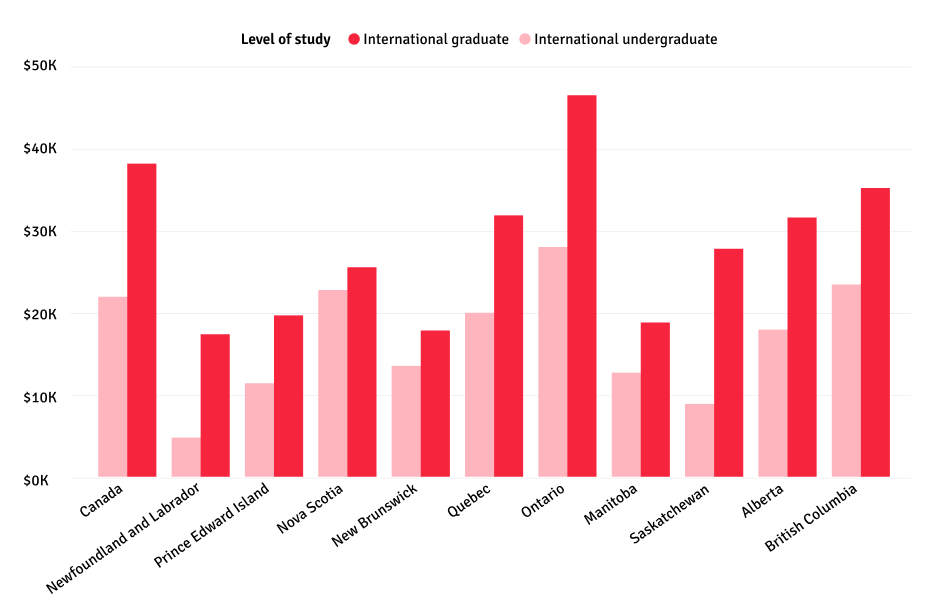
Source: Statistics Canada 2023
Careers
Whether you’re guiding students, supporting families, or helping people recover from addiction, every counselling career makes a meaningful impact. Counsellors work in schools, clinics, correctional facilities, private practices, and community organizations, adapting their expertise to diverse populations and needs.
Grief Counsellor – $42,000 – $70,000
Working in hospices, funeral homes, hospitals, or at a private practice, grief counsellors use compassionate, client-centred techniques to help individuals process their grief, whether from loss and bereavement, divorce, or other major life changes.
Career Counsellor – $50,000 – $64,000
Career counsellors help clients identify career paths that align with their interests, skills, and work experience, and may offer guidance on job searching, resume building, and interview preparation. These professionals are often employed in schools, rehabilitation centres, HR departments, consulting firms, correctional facilities, and government programs.
School Counsellor – $53,000 – $80,000
School counsellors support students’ academic, social, and emotional development. Working in elementary and high schools, they provide individual counselling, run social skills groups, address behavioural issues, and help with post-secondary planning. They also collaborate closely with teachers, parents, and administrators.
Addiction Counsellor – $54,000 – $93,000
Addiction counsellors specialize in supporting individuals dealing with substance use or behavioural addictions. Working in detox centres, rehab programs, hospitals, and community health organizations, these professionals often facilitate one-on-one sessions and group therapy, and coordinate care plans with medical teams.
Psychotherapist – $60,000 – $118,000
Psychotherapists use talk-based therapy to help clients explore emotions, behaviours, and relationships. They may specialize in modalities such as cognitive behavioural therapy (CBT), dialectical behaviour therapy (DBT), or trauma-informed care, and often work in private practice, wellness clinics, or multidisciplinary teams.
Clinical Counsellor – $62,000 – $130,000
Clinical counsellors assess, diagnose, and treat a range of emotional and mental health issues, and may work in therapy centres, hospitals, government agencies, rehabilitation facilities, and private practice. Approaches may include cognitive-behavioural therapy, trauma-informed care, and other evidence-based techniques tailored to individual needs.
Marriage and Family Therapist – $62,000 – $137,000
Typically working in private practice, family service agencies, or specialized mental health clinics, these therapists focus on relationships, helping couples and families navigate conflict, communication challenges, and life transitions.
Registered Nurse Psychotherapist – $69,000 – $101,000
Registered nurses with specialized training can become licensed to practise psychotherapy in certain provinces, such as Ontario. These professionals combine clinical nursing knowledge with therapeutic techniques to support patients experiencing anxiety, depression, trauma, and other mental health concerns. They often work in hospitals, community clinics, and private practices, offering a unique blend of physical and psychological care.
Child Psychologist – $84,000 – $125,000
A child psychologist helps children and adolescents manage emotional, behavioural, developmental, and mental health challenges. Often holding PhD degrees, child psychologists use therapy, assessments to support healthy psychological growth, helping youth navigate issues like anxiety, trauma, learning difficulties, and more.
Psychologist – $82,000 – $212,000
While not all psychologists are counsellors, many provide advanced therapeutic services, and are also trained in counselling. Often requiring a PhD degree, registered psychologists work in private practices, hospitals, correctional institutions and more, and are trained to assess, diagnose, and treat complex mental health disorders.
Salaries
The average salary for a certified counsellor or registered psychotherapist in Canada is $74,000 a year, with more senior counsellors earning upwards of six figures as they gain experience in their practice.
Here is a closer look at salary ranges based on job type and seniority, using data from Indeed, Talent.com, Glassdoor, and Canada’s Job Bank:
| Role | Average Salary in Canada |
|---|---|
| Grief Counsellor | $54,000 |
| Career Counsellor | $56,567 |
| School Counsellor | $65,000 |
| Psychotherapist | $74,000 |
| Clinical Counsellor | $84,805 |
| Addiction Counsellor | $85,829 |
| Registered Nurse Psychotherapist | $91,280 |
| Child Psychologist | $103,000 |
| Marriage and Family Therapist | $103,253 |
| Psychologist | $104,000 |