


An Executive MBA or EMBA isn’t about adding another credential to your resume. It’s about stepping into bigger leadership roles, sharper decision-making, and enterprise-level responsibility. For professionals already managing people, budgets, and strategy, an EMBA is one of the fastest ways to move from operational leadership into the executive ranks. Canadian EMBA programs are recognized globally and attract experienced leaders from across the country and abroad.
An EMBA is designed specifically for professionals already leading. Unlike traditional MBA programs, which focus on foundational business skills for earlier-career professionals, EMBA programs serve those managing teams, budgets, and strategy today. While core subjects may overlap, EMBAs place greater emphasis on applied leadership, peer learning, and real-world decision-making—delivered through flexible formats built around full-time work, including weekend, modular, and blended schedules. (If you’re weighing the difference, our guide to MBA vs. EMBA including admission requirements breaks down which path makes the most sense at different career stages.)
That focus translates into a strong return on investment. According to the Executive MBA Council’s 2025 Student Exit Survey, graduates reported an average 17.5 percent increase in salary by program completion, with 40 percent receiving promotions during the program. More than half also reported expanded responsibilities at work. These results underscore the degree’s ability to drive career progression without requiring professionals to step away from their roles.
Today’s leading programs go further, integrating digital strategy, analytics, global business exposure, and executive coaching to prepare leaders for enterprise-level decision-making. CourseCompare’s ranking reflects this landscape, assessing academic quality, leadership development, cohort experience, delivery flexibility, career outcomes, and ROI to identify the programs best positioned to support ambitious professionals.
Here are the best executive MBA programs of 2026.
CourseCompare’s annual school rankings are determined using a process that considers several core metrics and principles. Read more about our methodology here.
Schulich School of Business


York University’s Schulich School of Business is known for its global reach, innovative programming and the diversity of its student body, faculty and staff. Schulich enrolls approximately 3,000 students across its undergraduate, graduate and postgraduate business degree programs. The school operates from two Toronto locations, with its main campus at York University and its downtown Miles S. Nadal Management Centre in the city’s financial district.
Schulich also maintains a global footprint through executive education centres in India, China, South Korea, and Brazil, extending its network into major international business hubs and supporting both corporate training and global partnerships.
The Kellogg-Schulich Executive MBA is part of the Kellogg School of Management’s global EMBA network and is ranked #1 in Canada by both The Economist and the Financial Times.
What Sets Schulich School of Business at York University Apart?
The Kellogg-Schulich EMBA, offered jointly with Northwestern University’s Kellogg School of Management, is built around flexible scheduling and a strong global network. The program runs from January to May of the following year, with classes held every third weekend to support full-time careers while maintaining an immersive cohort experience. Students work through case studies, behavioural simulations, team-based discussions, and applied leadership exercises. Throughout the program, candidates participate in Kellogg Live-In Weeks and a Global Electives Week, joining executives from partner schools across the international Kellogg EMBA network.
Cohorts typically include mid-career managers, entrepreneurs, and high-potential leaders. Students average 39 years of age, bring roughly 15 years of professional experience, and have lived or worked in more than 20 countries, creating a globally experienced executive classroom.
What Students Are Saying
Aviva Lopez, Kellogg Executive MBA Global Network“After working as in-house counsel for a decade, I decided I wanted to go into private practice. I enjoyed law but fatigue was setting in and I wasn't learning the way I used to. The Kellogg-Schulich EMBA accelerated my transition into the c-suite. The students are incredibly diverse and have brilliant perspectives to share on leadership and management. And the name recognition of Kellogg, a prestigious US brand, doesn't hurt. I didn't appreciate this when I enrolled, but the joint US-Canadian credential opened new doors for me in the States, where I now work as an executive for an e-commerce company. Brilliant people, superb name recognition, and phenomenal students and professors -- many of whom are now colleagues. That's what you can expect from this global program. ”
The Curriculum
The Kellogg-Schulich Executive MBA is an approximately 18-month program that begins in January and finishes in late spring of the following year. Classes are held every third weekend, using a mix of in-person class weekends, live-in weeks and international modules to minimize time away from work while maintaining an intensive cohort experience.
Year one is built around core courses taught at Schulich and organized into five executive skill areas: leadership, strategic thinking, cross-functionality, ability to drive results and core financial understanding. Students move through modules such as Becoming a Global Leader, Mastering the Fundamentals and Managing for Excellence, and complete a Social Entrepreneurship and Innovation Project overseas that focuses on sustainable solutions to real social challenges.
In year two, the focus shifts to customization and global perspective. Candidates choose global elective modules at Kellogg partner schools in locations such as Chicago, Miami, Beijing, Hong Kong, and Vallendar, Germany, typically taking two electives over an intensive 10-day block while working in multinational teams. They also participate in Schulich Global Weekend and Schulich Global Week in Toronto, rounding out the program with advanced electives aligned to their leadership and career goals.
Locations
Toronto, Ontario
Rotman School of Management


The University of Toronto appears consistently in global university rankings and is widely recognized for the breadth of its research and alumni impact. Rotman School of Management, based in Toronto’s financial district, builds on that foundation through its work in Integrative Thinking, behavioural economics, and data-driven leadership. It also maintains one of the most extensive portfolios of graduate management programs in Canada.
Among the class of 2024, graduates reported an average salary increase of 18 percent between program start and graduation, and 48 percent made a career change within one year of completing the degree.
What Sets Rotman School of Management at University of Toronto Apart?
Rotman’s Executive MBA is a 13-month program designed for mid-career professionals who want a concentrated format without pausing their careers. The structure blends weekend classes, evening sessions, and online components across four terms, giving students consistent momentum while keeping the schedule manageable for those in senior roles.
Leadership development is a core emphasis. Through Rotman’s Integrated Leadership Framework, students work with personalized assessments, one-to-one coaching, and team-based feedback to map out a practical leadership trajectory they can apply immediately.
Rotman also delivers two specialized pathways: the Global Executive MBA and the Global Executive MBA for Healthcare and the Life Sciences, each an 18-month program that includes international modules in locations like Rotterdam, Singapore, Mumbai, and Silicon Valley.
What Students Are Saying
Diane, One Year Executive MBA“I came into Rotman’s EMBA with solid experience, but I wanted to break the ceiling and move into a new level of responsibility — to lead with more confidence and clarity. What surprised me most wasn’t just the course content, but the people. In my cohort, I met senior leaders, entrepreneurs, and women who’d broken serious ground in their industries. The strategy modules were a highlight, and learning to make data-backed decisions has already changed how I lead. Juggling kids, work, and the program was demanding, but the support system from faculty to classmates was again, rock solid. ”
The Curriculum
Rotman’s EMBA starts with analytical and functional foundations, builds toward advanced strategy and leadership, and ends with applied organizational change work. Early modules introduce core areas such as marketing, economics, accounting, quantitative reasoning, and personal leadership. Mid-program coursework shifts into strategy, corporate governance, finance, operations and applied ethics, combined with a leadership practicum that supports executive skill development.
Later terms focus on negotiations, power and influence, advanced strategy, and an elective option, followed by a final block dedicated to strategic implementation, sustainable venture design and a supervised capstone that applies Rotman’s integrative problem-solving framework to a real organizational challenge.
Locations
Toronto, Ontario
Ivey Business School
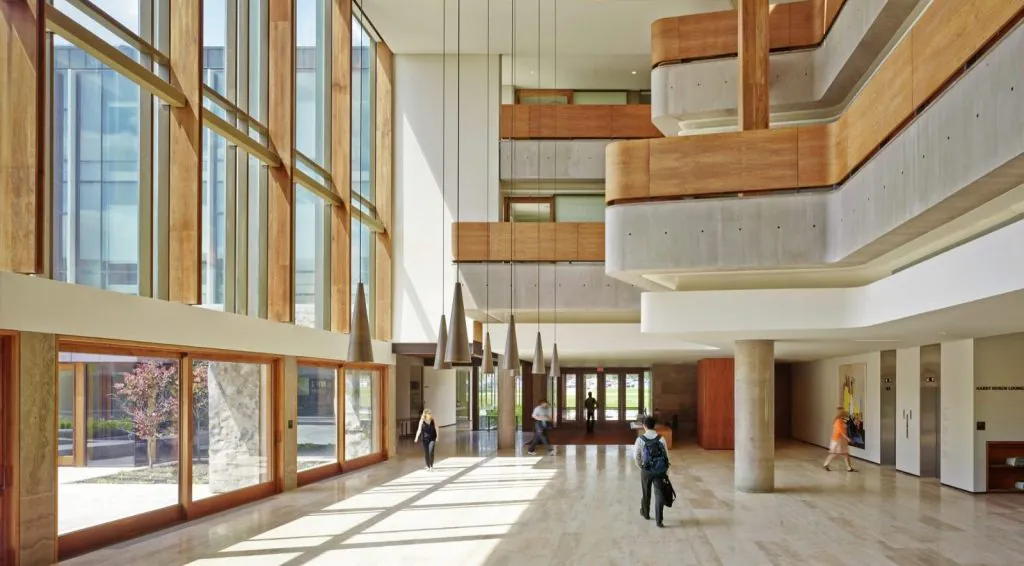

Western University is one of Canada’s most research-intensive institutions and home to several nationally ranked professional schools, including the Ivey Business School. Known for its strong alumni network and leadership programs, Western consistently appears in global university rankings and draws students from across Canada and worldwide.
Ivey has a strong reputation for experiential business education and long-standing strength in case-method teaching. Its executive programs attract senior leaders from a wide range of industries, supported by faculty with deep expertise in strategy, finance, leadership, and organizational behaviour.
What Sets Ivey Business School at Western University Apart?
Ivey’s EMBA is built entirely around the case method, placing students in complex, ambiguous business situations from day one. Participants work through hundreds of cases over the program, refining judgement, sharpening analysis, and learning to communicate decisions with clarity. Each cohort includes senior leaders from across industries, which pushes classroom discussions into deeper, experience-driven territory.
The program structure is designed for executives who need a predictable schedule without sacrificing intensity. Students meet for four consecutive days each month at the Toronto campus and take part in three week-long residential sessions in London. Two international trips expand the program’s global focus through direct exposure to business innovation hubs and emerging markets.
What Students Are Saying
Mark Bloch, Executive MBA“Ivey provides a singularly unique educational setting that is second to none in Canada. Utilizing the case study method, Ivey prepares its students for life outside school, allowing them to read, analyze, breakdown and solve complex real world business scenarios. There is simply no better place to learn and grow as a person, student and future professional. ”
The Curriculum
Ivey’s EMBA includes 18 courses covering strategy, leadership, finance, operations, negotiations, risk, sustainability, and cross-functional management. Ivey structures the program around its Leadership Essentials, which bring together environmental analysis, strategy development, execution, and talent management. Case discussions, team projects, and applied leadership exercises are woven into every stage of the program.
The program includes a mandatory week-long Global Learning Experience. Destinations in recent years have included Vietnam (2024–2025), and Chile. The trip is framed as a Discovery Expedition focused on company visits, market analysis, and meetings with business leaders.
Locations
London, Ontario; Toronto, Ontario
Smith School of Business at Queen's University
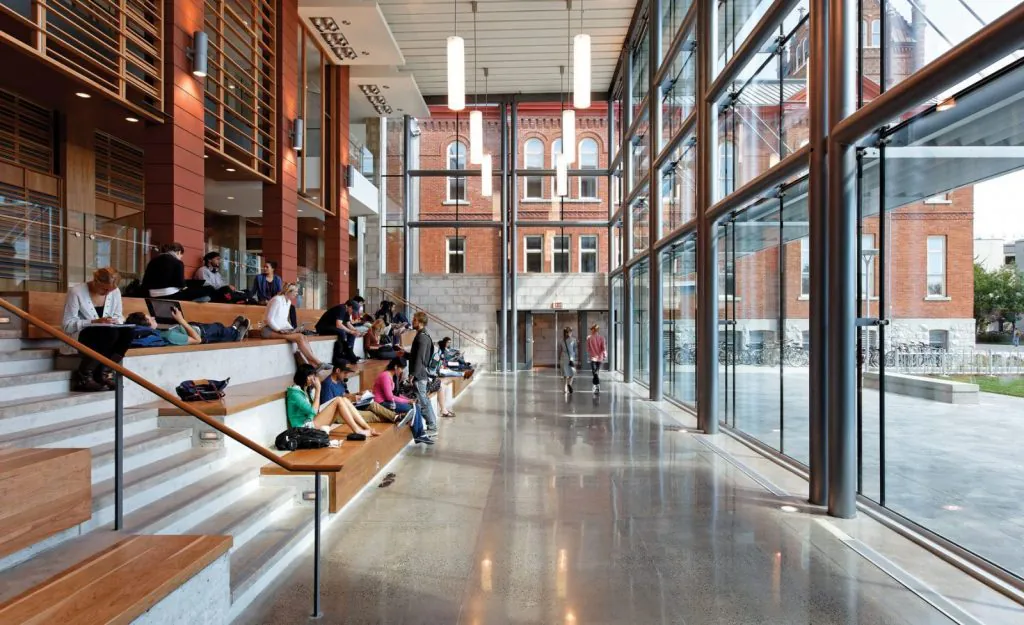

Queen’s is one of Canada’s leading research institutions, known for its strong alumni community and national presence across business, public service, and engineering.
Smith is the only business school in Canada offering two distinct Executive MBA pathways: a nationwide real-time program for professionals who want to study from their home city, and a dual-degree program delivered with Cornell University for executives seeking a cross-border learning experience. This gives Smith an unusually broad footprint in executive education, with classrooms connected across Canada, the United States and South America.
The school is known for team-based learning, structured coaching and technology-enabled delivery that supports professionals who want to advance without stepping away from their careers. Both EMBA options emphasize applied leadership development, collaborative problem-solving, and a high level of academic and logistical support.
What Sets the Smith School of Business Queen’s Apart?
Smith’s delivery model is designed for working executives who need flexibility without sacrificing real-time interaction. The National Program uses Smith’s Interactive Teaching Studio to connect students in boardroom learning centres across Canada, supporting live discussion, case work, and the school’s well-known emphasis on collaborative learning.
A defining feature is the school’s coaching model. Participants work with an executive coach, a career coach and a team coach, along with access to a lifestyle coach who provides support on personal well-being, performance habits and sustainable workload management. This coaching framework runs throughout the program and integrates with team projects and leadership development.
While the two EMBA formats differ in delivery and scope, both reflect Smith’s emphasis on applied learning, collaborative teamwork, and structured leadership development.
What Students Are Saying
Adam Cooney, Executive MBA - The National Program“The program gave me an edge in my day-to-day business dealings and ultimately boosted my confidence to take my family business to the next level. I loved the videoconference technology. It felt as if you were right there in the front row of the class, and the professor– student interaction was wonderful. This program is not for the faint of heart, but I couldn’t imagine where I would be today without it. ”
The Curriculum
Executive MBA – National Program (16 months)
Full-day classes take place every second Friday and Saturday morning. The curriculum is organized into seven integrated modules covering strategic leadership, organizational performance, innovation, analytics, execution, and global business perspectives.
Learning includes case discussions, simulations, team projects, and applied leadership assignments. A central component is the Global Business Project and International Study Trip, which places participants in an international market to analyze business conditions and apply strategic frameworks in practice.
Executive MBA Americas (18 months, dual degree)
The curriculum covers management fundamentals, strategic thinking, innovation, global business, and leadership. Courses are delivered through multi-city classrooms supported by team-based learning and dedicated team coaches.
The program includes multiple residential sessions across Canada and the United States, along with a Global Business Project that takes participants to an international destination outside their home country to work with a local organization on a real business challenge.
Locations
Live Online; Kingston, Ontario
McGill Desautels Faculty of Management


McGill University has a long-standing international profile, drawing students and faculty from around the world and maintaining one of the most globally recognized alumni networks in Canada. Its location in the centre of Montreal adds a distinct advantage: a bilingual business environment and strong ties to finance, healthcare, technology, and the city’s expanding startup sector. Desautels thrives in this setting, with management programs known for analytical depth, cross-disciplinary work and an international student base.
The McGill–HEC Montréal EMBA is delivered jointly by McGill and HEC Montréal and is the only bilingual executive MBA program in Canada. The partnership combines McGill’s strength in global management with HEC Montréal’s expertise in applied business education and Quebec’s economic landscape. The result is a program designed for senior leaders who want broader strategic range, exposure to multiple managerial cultures and the ability to operate comfortably in English and French.
What sets Desautels Faculty of Management at McGill University apart?
The program is organized around a series of themed learning blocks known as Managerial Mindsets. Instead of traditional functional courses, each mindset looks at management through a practical theme, such as how leaders analyze issues, work across functions, build collaboration, drive innovation, or navigate global markets. The work is applied and discussion-driven, drawing on the experience executives bring to the room rather than introductory theory.
One of the key experiential components is the Managerial Exchange, where participants spend several days working inside another cohort member’s organization, then host that peer in their own. The exchange gives executives a close view of how different industries and leadership cultures operate day to day.
The Curriculum
The program runs for about 15 months and is organized into a series of modules that move from individual analysis to organizational leadership and global strategy. Each module combines case work, executive simulations, and applied assignments that draw directly on participants’ work experience.
A dedicated international module places the cohort in a business centre in Latin America or Asia. Students meet with local organizations, study regional market conditions, and complete an applied project. Another experiential feature is the managerial exchange, where participants spend several days inside a peer’s organization and later host that peer in their own workplace. This component provides a direct look at how different companies make decisions and manage operations.
Locations
Montreal, Quebec
University of Alberta


The University of Alberta is known for strong graduate outcomes and a deep focus on experiential learning, career development and applied research. Its Alberta School of Business is one of the country’s longest-established management schools and the first in Canada to earn AACSB accreditation, a distinction held by fewer than 30 Canadian institutions.
The school attracts experienced professionals from across sectors, and its EMBA cohort profile reflects that reach: participants average more than 16 years of work experience, represent a wide range of industries, and come to the program from major employers across government, energy, finance, consulting, and technology.
What Sets the Alberta School of Business at the University of Alberta Apart?
U of A’s EMBA is built around applied leadership development and direct industry engagement. Each participant selects an executive coach from the school’s roster of experienced business leaders, creating a one-to-one coaching relationship that continues through the entire program. This is paired with cohort-wide leadership development sessions that emphasize practical decision-making and resilience in complex environments.
The program also distinguishes itself through its integration with Edmonton’s business community. Guest speakers, applied projects and elective choices are developed in collaboration with local industry, giving participants frequent exposure to regional decision-makers and real operational challenges.
The Curriculum
The EMBA runs over 22 months and is delivered in person at the Edmonton campus. Participants move through a set of core courses that cover strategy, finance, operations, leadership, organizational analysis, and managerial decision-making. Electives shift each year because the cohort selects them as a group, which is how courses like entrepreneurial strategizing, venture creation or sector-specific strategy end up in the mix.
Classes follow a concentrated format: most courses run in four-day blocks from Thursday through Sunday, making it possible for participants to keep a full professional workload while moving through substantial material.
The international business course includes a study tour where participants spend several weeks examining market conditions and organizational practices in foreign business centres. In the past, students have travelled to Germany and Japan for company visits, briefings, and applied assignments.
Locations
Edmonton, Alberta
DeGroote School of Business


McMaster University is known for research strength in health sciences, engineering, and business, and its DeGroote School of Business reflects that interdisciplinary orientation. The school focuses heavily on innovation and applied learning, drawing mid-career professionals who want management training grounded in real organizational change rather than abstract theory. McMaster’s footprint across Hamilton and the GTA also supports strong industry partnerships and executive education demand in one of Canada’s fastest-growing economic regions.
What Sets DeGroote School of Business at McMaster University Apart?
DeGroote offers a distinctive program that stands out from the rest in this list: Executive MBA in Digital Transformation. Instead of running a traditional general-management EMBA, DeGroote positions its program around how organizations navigate digital disruption. Participants study strategy, finance, leadership, and organizational transformation along with advanced analytics, data-driven decision-making, digital systems architecture, and innovation management.
The structure is intentionally small-scale. With a class cap of 25, students work closely with faculty and coaches, and each receives individual support through the Personal Leadership Effectiveness program, which includes one-to-one coaching throughout the 14-month experience.
The program also stands out for its applied orientation. Executive projects, analytics labs, innovation sprints, and organizational transformation work give participants repeated opportunities to test new skills on real problems rather than treating digital transformation as a theory module.
The Curriculum
The 14-month format combines online learning with periodic in-person modules in Hamilton and Toronto. Course themes include digital strategy, data analytics, entrepreneurship, process innovation, organizational design, and leadership coaching. A multi-term capstone runs alongside the curriculum, allowing each participant to apply digital transformation concepts directly to a workplace or industry challenge.
The program includes an international residency focused on digital innovation and global business ecosystems. Recent students have travelled to Silicon Valley, participating in sessions hosted by faculty at Stanford University, conducting site visits with technology firms and meeting with practitioners working in product design, AI, venture capital, and digital operations.
Locations
Hamilton, and Toronto, Ontario
Concordia University John Molson School of Business


Concordia sits in downtown Montreal, a city known for its mix of global commerce, creative industries, and startup culture. The John Molson School of Business is tightly woven into that environment. The school operates out of a LEED-certified building on the city’s primary business corridor, steps away from major finance, aerospace, tech, and consulting firms that routinely collaborate with JMSB faculty and students.
John Molson is also one of the oldest business schools in Canada under continuous operation. Its roots trace back to 1960, and the school has since developed international credibility in case competition excellence, sustainable business research, and experiential learning.
Their EMBA emphasizes applied leadership, cross-functional problem solving, and direct exposure to seasoned executives. It churns out highly employable grads as well, with a mean salary of $113,250 and a 100 percent of EMBA graduates employed within three months of graduation as of 2024.
What sets John Molson School of Business at Concordia University apart?
John Molson’s EMBA is built around a leadership-focused, executive-supported learning model that few Canadian programs replicate. Each cohort is assigned to a senior business leader called a Class Champion who stays with the group for the entire 20-month program. The Class Champion is actively involved in students’ learning: participating in discussions, offering strategic guidance, helping teams pressure-test ideas, and providing an external vantage point executives rarely get inside their own organizations.
The school’s reputation in case-based learning and experiential education also shows up throughout the EMBA. John Molson is home to one of the world’s most established and decorated case competition programs, drawing corporate partners and judges from across North America every year. The culture of applied, scenario-driven learning informs how courses are taught, how teams work, and how leadership development is framed.
Another distinctive element is the program’s emphasis on personal awareness and ethical decision-making. The curriculum pushes beyond technical competence toward reflection on values, responsibility, and the long-term implications of managerial choices, supported by faculty who blend academic expertise with industry experience.
Team coaching is integrated into the structure, and a dedicated team coach works with each learning group on communication, conflict navigation, decision processes, and leadership habits, shaping the collaborative skills executives rely on.
What Students Are Saying
Chris Lafleur-James“With a beautiful modern building, friendly and social atmosphere, and a number of high-quality professors, JMSB is a great place to study. It is a progressive school that is constantly looking towards the next step, and will soon be a benchmark business school. ”
The Curriculum
The EMBA is delivered over 20 months, with classes held one full day per week on alternating Fridays and Saturdays. The program is organized into four themed semesters. Each theme frames the learning for that term, from core managerial foundations to global integration, creative problem-solving, and organizational change.
Throughout the program, courses are taught through applied cases, team projects, and structured coaching. At the end of each semester, an integrative course brings together the term’s concepts in a consolidated, real-world application exercise.
The second semester includes a two-week international study trip, giving participants direct exposure to a different business environment and the opportunity to analyze market conditions, industry structure, and cross-cultural management practices.
Locations
Montreal, Quebec
University of Fredericton (UFred)


The University of Fredericton is a fully online institution based in New Brunswick, known for career-focused graduate business programs designed for working professionals across Canada.
UFred’s EMBA attracts a particularly experienced cohort. Historical data shows that 98 percent of participants are employed, have an average of 22 years of professional experience, and represent nearly 30 industries, creating a classroom environment built around peer expertise and applied discussion. As of 2024, UFred reported a graduate employment rate of 94 percent within one year of graduation for its MBA and EMBA programs, with an average base salary of $135,000.
What Sets the University of Fredericton Apart?
UFred’s Executive MBA is one just two exclusively online EMBA programs in Canada. Classes are held weekly via live virtual classes led by faculty with industry backgrounds. Each course integrates recurring team assignments that rely on the leadership and operational experience of the cohort.
The program also stands out for its range of 11 specialty streams, allowing participants to match their degree to a specific functional or industry focus, from consulting to global leadership to health systems. This level of specialization is uncommon in Canadian EMBA programs.
UFred’s EMBA is accredited by the Accreditation Council for Business Schools and Programs (ACBSP) and is provincially authorized under New Brunswick’s Degree Granting Act.
What Students Are Saying
Joshua Linde, Executive MBA“I applied to the University of Fredericton Executive MBA program in 2023. As I had pursued a culinary career and did not complete an undergrad. Launching into the workforce and leading people for 2 years before UFRED garnered me conditional acceptance (I had to maintain a B+ minimum average for the foundational first 6 months of the program). My fears were that a fully remote MBA would a) potentially be a poorer learning experience and b) prevent the opportunity to network and develop relationships with my cohort. These fears dissipated throughout the program; I attended multiple networking events, allowing me to meet Alumni and current students in all MBA programs. I met some amazing, high level business leaders who will become lifelong friends. Most importantly, the work was challenging and compelling, and with the exception of two poor classes (every program has duds) I learned enough to be dangerous in the key business fields. Should you want to work at a large corporation who values certain schools, go to Queens or Western. If you want an MBA to bolster your professional career, which allows you the flexibility to juggle work, family, personal life and school - this program is darned perfect. ”
The Curriculum
The EMBA consists of 14 courses delivered over 1.5 to 2.5 years, depending on pace. Students take one live online class per week per course, typically in the evening, supported by asynchronous readings, case work, and team projects.
The curriculum begins with a set of foundational seven-week courses covering economics, strategy, leadership theory, and organizational analysis. Participants then move into their specialty stream, where advanced courses focus on applied problem-solving and sector-specific decision-making.
The program concludes with a group capstone with four options:
- Enterprise Integration Project
- Entrepreneurial Capstone
- Global Capstone
- Global Capstone with International Field Study (Requires travel to a global business hub to examine economic conditions, cross-cultural management, and international strategy in practice.)
Locations
Online
Simon Fraser University Beedie School of Business

Simon Fraser University is known for its strong research profile, applied learning culture, and deep ties to industry across British Columbia. With campuses in Burnaby, Surrey, and downtown Vancouver, SFU attracts working professionals from across the region, offering access to a major West Coast business hub and a university recognized for innovation, community engagement, and comprehensive academic programs.
Since launching Canada’s first EMBA in 1968, Beedie has built a reputation for rigorous, experience-driven management education that draws mid- to senior-level professionals from a range of sectors. Recent career outcomes underscore the program’s impact: 59 percent of graduates report a job-level increase soon after completion, 48 percent change companies, and 41 percent move into a new job function.
What Sets the Beedie School of Business at SFU Apart?
Beedie’s EMBA is built around executives with an average of 21 years of experience. Year one is team-based, with cohorts organized into simulated leadership groups designed to replicate senior management environments. These teams tackle applied projects, case analyses, and decision-making exercises tied to current business challenges, creating a highly interactive learning space.
A standout feature is the Americas MBA for Executives, an optional second-year pathway delivered jointly with partner schools in the United States, Mexico, and Brazil. Students travel to each partner campus for modules that explore regional markets, leadership practices, and cross-border strategy.
What Students Are Saying
Dennis Thomas-Whonoak, Executive Masters of Business Administration“The whole experience has been so culturally, emotionally, and socially rewarding. Not only was I able to share the work that I've been doing, but also meet new indigenous professionals across Canada and the U.S. I was able to hear different perspectives and utilize the knowledge I absorbed through the professors and incorporate them into my day-to-day work. It's been a transformative experience for me - personally and professionally. ”
The Curriculum
SFU’s EMBA is a 20-month program with full-day classes on alternating weekends, designed for working executives who want a rigorous but manageable schedule.
Year one develops core leadership and management competencies, with courses in finance, managerial economics, business ethics, organizational behaviour, strategy, and teamwork. Applied learning is embedded through simulations, case work, team projects, and leadership-focused assignments.
Year two diverges into two paths:
- The standard EMBA stream, delivered in Vancouver, which continues with advanced courses in negotiations, innovation, and cross-cultural management.
- The Americas MBA for Executives, which replaces some domestic coursework with international modules in the U.S., Mexico, and Brazil, emphasizing regional strategy, global markets, and international collaboration.
Locations
Burnaby, British Columbia
Telfer School of Management


The University of Ottawa is home to Canada’s largest bilingual campus and has long played a major role in public administration, health, law, and business across the National Capital Region. The Telfer School of Management draws executives from federal departments, national associations, and Ottawa’s expanding tech sector.
Telfer’s EMBA is delivered in English, but faculty are bilingual, many assignments can be submitted in English or French, and cohorts often include a significant number of Francophone professionals who work in government or cross-border industries.
What Sets Telfer School of Management at the University of Ottawa Apart?
Telfer’s EMBA is built around applied consulting work rather than standalone courses. Throughout the program, students complete six integrated consulting projects, each aligned to a specific stage of the curriculum. These projects let participants test new skills with real clients, refine their executive communication, and work through the ambiguity that defines senior-level decision-making.
Two of these projects take place internationally. The innovation and entrepreneurship project is delivered in Silicon Valley, where students examine early-stage business models, meet with founders, and assess innovation practices directly inside the tech ecosystem. The international expansion project places teams in a global business centre selected by the cohort, with past locations including China, Chile, India, Poland, South Korea, Italy, and South Africa. These projects require market analysis, feasibility assessment, and client recommendations grounded in local conditions.
Telfer also offers a Complex Project Leadership concentration for executives who oversee large programs, technical initiatives, or multi-stakeholder environments. The concentration adds targeted tools in risk, systems thinking, and project governance for leaders who work in sectors where complexity is the norm.
The Curriculum
Telfer’s EMBA runs for 21 months with in-person classes on alternating Fridays and Saturdays. The academic content is delivered across four terms and covers strategic management, finance, marketing, governance, operations, supply chain management, analytics, and organizational change.
What differentiates the program is how these concepts are applied. The six consulting projects run alongside coursework, creating a continuous cycle where students learn a framework one week and use it with a client shortly afterward. Each project becomes progressively more complex, moving from diagnostic work to strategy development, implementation planning, and international market analysis.
The international components are embedded within the curriculum rather than treated as add-on travel. The Silicon Valley residency supports the innovation and entrepreneurship project, while the global business residency supports the international expansion project. Together, they anchor the program’s applied learning model and expose participants to decision-making in unfamiliar markets and high-growth environments.
Locations
Ottawa, Ontario
University of Calgary Haskayne School of Business


The University of Calgary sits at the centre of one of Canada’s fastest-growing metropolitan regions, with strong ties to energy, technology, health innovation, and entrepreneurial sectors across Alberta. The Haskayne School of Business reflects that environment through a focus on applied leadership and industry engagement. Haskayne School of Business is known for close industry engagement, strong alumni networks, and direct access to senior leaders across Western Canada.
The Executive MBA is built for mid-career professionals who want a program that emphasizes applied decision-making, leadership development, and hands-on exposure to real venture and innovation ecosystems. The average learner is 39 years old, with nearly 15 years of experience; 33 percent of the 2023 cohort held a title of director or more senior.
What Sets Haskayne School of Business at the University of Calgary Apart?
Haskayne integrates its EMBA directly with Calgary’s innovation and venture ecosystem. Along with core coursework, students choose an applied pathway that anchors the program in real business challenges. Students seeking deeper expertise can opt into a finance stream that extends the EMBA’s leadership and strategy focus into advanced financial modelling, valuation, and market analysis. This blend of applied learning, industry access, and optional specialization gives the program a distinctive shape within Western Canada’s business landscape.
What Students Are Saying
Frank T., Haskayne Executive MBA“Every other weekend I and for one evening each week, more or less, I attended the Executive MBA program. I volunteered with CDL (Creative Destruction Lab) and got to know the local startup scene and made connections to business leaders and founders. The EMBA was a great experience and led to significant growth in terms of my mindset and outlook, connections and knowledge. It was worth the hefty price tag. I got a promotion with a 20% raise after graduating. My only caution is that I live and work in Calgary so I was able to leverage my networks to great effect. A friend and colleague had ambitions of moving to the US after his program and sometimes regrets not applying to a US college. As usual, the EMBA boils down to what you want to get out of it. ”
The Curriculum
Haskayne’s EMBA runs for 22 months and blends four immersive block weeks with classes held on alternating weekends. The program includes 20 courses delivered over four semesters, covering leadership, accounting, finance, strategy, innovation, operations, economics, business analytics, and organizational behaviour.
Students add depth through two electives, which vary each year. Previous offerings have included negotiations, mergers and acquisitions, digital marketing, and strategies for sustainable development.
A global learning component is built into the final stages of the program through a 10-day international study tour featuring company visits, economic briefings, and applied analysis of region-specific business environments.
To finish the degree, students choose one experiential pathway:
- Capstone project
- Participation in the IXL Innovation Olympics
- Placement with the Creative Destruction Lab
Each option applies EMBA-level learning to a real business challenge and expands professional networks in different ways.
Locations
Calgary, Alberta
Saint Mary’s University Sobey School of Business


Founded in Halifax in 1802, Saint Mary’s is one of Canada’s oldest universities and one of the first to establish a dedicated faculty of commerce. That faculty became the Sobey School of Business in 1992, named for Frank Sobey, whose family built one of the country’s largest retail enterprises. The school has since developed a national reputation for applied management education rooted in Atlantic Canada’s strong business and entrepreneurial culture.
What Sets Sobey School of Business at St. Mary’s University Apart?
The Sobey School is one of the few Canadian business schools that has built its EMBA around evidence-based management, a discipline that trains leaders to base decisions on the strongest available research rather than habit, instinct, or anecdote. Students learn to pull insights from academic studies, organizational data, practitioner expertise, and stakeholder perspectives, then apply those findings to real strategic problems.
In 2020, the Sobey EMBA became the first in Canada to earn accreditation from the Center for Evidence-Based Management (CEBMa). The result is a program that develops leaders who can evaluate information rigorously, think systematically, and navigate uncertainty with a clearer analytical lens.
The Curriculum
Sobey’s 16-month EMBA is delivered over four semesters and combines intensive in-person classes every third weekend with structured self-paced modules between sessions. The curriculum is built around five conceptual areas: functional management, management foundations, international perspectives, practice-oriented research, and executive development.
Core coursework covers accounting, strategic marketing, global economics, people in organizations, business intelligence and data analytics, ethics and governance, supply chain management, responsible leadership, international business, decision-making under uncertainty, and business strategy.
A hallmark of the program is its applied research sequence. Students complete a two-stage, practice-oriented research project guided by faculty supervision, where they investigate a real organizational challenge, conduct evidence appraisal, and present findings to peers and faculty.
The international trade mission remains a signature feature. Students act as consultants for Atlantic Canada companies, conducting market research and business development work in a selected international destination, gaining global insight and hands-on experience supporting local exporters.
Locations
Halifax, Nova Scotia
 Editorial Team