
-
 featured
 - featured
Tuition
$15,389
-

Tuition
$769
-

-

Tuition
$3,263
Scholarships available
-

Online
Jan 18 - Jan 18, 2030
Tuition
$3,400
Scholarships available
-

Tuition
$3,667


About

Demand for occupational health and safety (OHS) professionals is rising across every sector—from healthcare and construction to energy and tech. These specialists are experts in workplace safety legislation and play a critical role in reducing organizational risk while keeping employees safe.
OHS professionals design and implement safety protocols, conduct hazard assessments, lead safety training, and respond to emergencies. Many also address emerging concerns like workplace ergonomics, mental health, and environmental safety.
Canada’s top occupational health and safety certificate and diploma programs equip professionals with the skills to interpret legislation, perform audits, manage incidents, and build a culture of safety in diverse work environments.
OHS careers offer a clear path to leadership, with many professionals advancing into coordinator, consultant, and director-level roles. According to data from the Government of Canada and job market platforms, the average salary for an OHS professional is approximately $86,988 a year or $44.61 per hour.
Frequently Asked Questions (FAQ)
What is a safety professional?
Safety professionals—also known as occupational health and safety (OHS) specialists—help organizations identify and manage risks that affect employee health and workplace safety. They inspect job sites, equipment, and procedures, ensuring compliance with both internal protocols and provincial or federal regulations. Beyond inspection, these professionals conduct risk assessments, design safety training, and respond to incidents.
How do I become a health and safety specialist in Canada?
Most professionals begin with a bachelor’s degree in a related field such as health sciences, environmental science, engineering, or chemistry. From there, they complete a certificate or diploma in occupational health and safety from a recognized institution.
Certification from the Board of Certified Safety Professionals (BCSP) or the Board of Canadian Registered Safety Professionals (BCRSP) may be required depending on the job or province. Programs vary widely in length, from intensive eight-week courses to multi-year part-time diplomas.
What is the highest paid safety job?
The average OHS salary is around $87,000 annually, but senior-level roles like Chief Safety Officer or Director of Safety and Compliance can earn up to $131,000 or more, depending on industry and region.
What is the difference between a CRST and CRSP?
Both the Canadian Registered Safety Technician (CRST) and Canadian Registered Safety Professional (CRSP) are certifications issued by the Board of Canadian Registered Safety Professionals (BCRSP), but they represent different levels of qualification.
CRST is geared toward early-career professionals, safety technicians, and coordinators. It requires less experience and education but still demonstrates a foundational level of competency in OHS practices.
CRSP is intended for experienced safety professionals with more advanced responsibilities. It requires a bachelor’s degree or two-year OHS diploma, at least 48 months of work experience, and a broader scope of knowledge.
Many professionals start with the CRST and later progress to the CRSP as they gain additional education and experience. You can find which of Canada’s best OHS certificates and diplomas fulfill the requirements for each certification here.
How do I become a CRST in Canada?
To become a Canadian Registered Safety Technician (CRST), candidates must:
- Hold a high school diploma or equivalent
- Complete a recognized occupational health and safety (OHS) certificate or diploma program
- Have 12 months of OHS work experience obtained within the last 36 months
- Pass the CRST examination administered by the Board of Canadian Registered Safety Professionals (BCRSP)
The CRST is designed for entry-level OHS professionals or those in technician-level roles. It provides a recognized credential that can serve as a stepping stone to the CRSP designation.
How do I become a CRSP in Canada?
To earn the Canadian Registered Safety Professional (CRSP) designation, you’ll need:
- A bachelor’s degree in any discipline or a two-year OHS diploma from an approved institution
- At least 48 months of professional-level OHS experience, gained within the last six years
- Successful completion of the CRSP exam, which covers areas like risk management, safety audits, ergonomics, and applied safety principles
Once certified, CRSPs must meet continuing education requirements every five years to maintain their designation.
Certifications
In Canada, occupational health and safety legislation governs nearly every workplace—and certification can set professionals apart in a growing and competitive field. The two primary credentials issued by the Board of Canadian Registered Safety Professionals (BCRSP) are Canadian Registered Safety Technician (CRST) and Canadian Registered Safety Professional (CRSP).
Ideal for entry-level professionals, the CRST certification validates foundational knowledge in occupational health and safety. To qualify, candidates must hold a high school diploma or equivalent; complete a recognized OHS certificate or diploma program; have at least 12 months of OHS work experience in the last 36 months; and pass the CRST exam, which covers topics like hazard identification, inspections, incident response, and safety education. The CRST is well suited to those in technician-level roles, safety coordinator positions, or those new to the field.
The CRSP designation is designed for professionals in more senior or strategic safety roles. To qualify, candidates must hold a bachelor’s degree in any field, or a two-year diploma in occupational health and safety; accumulate at least 48 months of professional-level OHS experience within the last 72 months; submit an application and pass the CRSP exam, which includes content on risk management, safety systems, occupational hygiene, ergonomics, auditing, and regulatory compliance. The CRSP is widely recognized across Canada and internationally as a benchmark of advanced competency in the field.
Both designations require ongoing professional development. CRSTs and CRSPs must complete continuing education and ethics training every five years to maintain their certification.
Some professionals may also pursue additional credentials—such as the Certified Safety Professional (CSP) or Certified Health and Safety Consultant (CHSC)—depending on their specialization and long-term goals.
The Certificate in Occupational Health, Safety and Environmental Systems (COHSES) is part of the pathway to becoming an established OHS professional. Developed for learners from mid-level managers to front-line workers in every industry and sector, it aims to provide students … Continue reading
Tuition
$7,695
Tuition
$7,695
Get “recession-proof” skills for jobs in industries like construction, manufacturing, and healthcare with The Chang School of Continuing Education’s Certificate in Occupational Health and Safety. Now more than ever, employers need skilled professionals to ensure their workplaces are safe and … Continue reading
Tuition
$4,900
Scholarships available
Tuition
$4,900
Scholarships available

The Environmental Technician program at Mohawk College prepares students to play a vital role in protecting the environment and human health through cutting-edge technology and science. With a focus on practical, hands-on learning, students gain access to state-of-the-art lab facilities … Continue reading
Tuition
$5,524
Scholarships available
Tuition
$5,524
Scholarships available

This diploma program is designed to accommodate busy learners as an entirely self-paced, online learning experience from the University of New Brunswick. Students will learn from industry leaders about how how to operate in the business world, as well as … Continue reading
Oct 5 - Oct 5, 2028
Nov 2 - Nov 2 2028
Dec 7 - Dec 7 2028
Jan 4 - Jan 4 2029
Tuition
$6,750
Scholarships available
Tuition
$6,750
Scholarships available
The UFred Associate Degree in Occupational Health and Safety program provides students with the knowledge required to develop, implement and evaluate occupational health and safety programs and systems in the workplace. The courses offered in this program are based on independent … Continue reading
Tuition
$15,389
Tuition
$15,389

Students will learn the key areas of various industries including power generations, forestry, mining, construction, and healthcare, as they are taught by industry experts who understand current occupational health and safety legislation and issues. In this two year program, students … Continue reading

This 10-course diploma program provides you with the knowledge and experience to start your career in occupational health and safety management. Acquire the understanding of legislation, workplace hazards and occupational illnesses you need to manage the occupational health and safety … Continue reading
Tuition
$9,000
Scholarships available
Tuition
$9,000
Scholarships available

Students at the University of Alberta enrolled in the Occupational Health and Safety Professional Diploma program will learn from industry professionals and get the education they need to excel in the OHS field. This program was specifically designed with courses … Continue reading
Tuition
$13,000
Tuition
$13,000

Students looking for the first or next step in their occupational health and safety career can spend 40 weeks at Saskatchewan Polytechnic and explore career opportunities in several fields. Throughout this in-person program, students will gain valuable skills in safety … Continue reading
Tuition & Completion Data
Domestic

Last updated: September 25, 2026
International
See below for the latest data on international student tuition across Canada, excluding housing costs and ancillary fees.
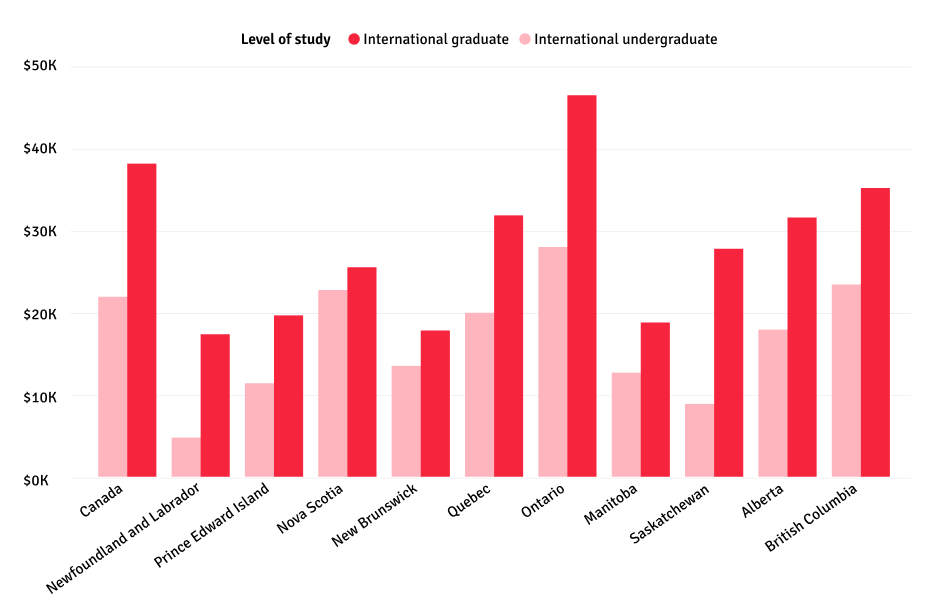
Source: Statistics Canada 2023
Careers
Occupational health and safety is a diverse field with a wide range of career pathways across industries. Whether a candidate is passionate about emergency response, data analysis, or workplace risk management, there’s a role to match their interests and strengths.
Below are some common specializations in the field, along with their average annual salaries in Canada:
Health Information Technician – $46,000 – $74,000
These professionals work in hospitals, clinics, workplace safety boards, and consulting firms to manage and analyze health data. By identifying patterns and trends in the data, they help organizations make informed decisions to improve public and workplace health outcomes.
Occupational Health and Safety Consultant – $52,000 – $80,000
OHS consultants assess workplaces for health and safety risks, conduct audits, and develop tailored safety programs. They help organizations identify hazards, ensure compliance with safety regulations, and implement preventative measures to reduce the risk of accidents and injuries.
Safety Coordinator / Trainer – $52,000 – $80,000
Safety coordinators or trainers are responsible for educating employees about workplace hazards, safety regulations, and emergency response procedures. They develop and lead training sessions, maintain safety documentation, and often serve as a point of contact between employees and management regarding health and safety concerns.
Ergonomist – $59,000 – $85,000
By adjusting workplace design—from office setups to industrial equipment—ergonomists help improve employee comfort, health, and productivity while reducing injury-related costs for employers. They do this by analyzing how people interact with their work environments and tools to reduce injury.
Construction Safety Manager – $61,000 – $101,000
Construction safety managers ensure that construction sites comply with federal, provincial, and local health and safety regulations. They perform site inspections, deliver safety briefings, investigate incidents, and enforce protocols to reduce workplace injuries in this high-risk sector.
Firefighter – $69,000 – $104,000
Firefighters safeguard lives, property, and the environment by responding to fires and hazardous incidents. Their duties can include rescuing individuals from dangerous situations, administering first aid, and educating the public on fire prevention and safety practices. Learn more about becoming a firefighter here.
Environmental Health and Safety (EHS) Specialist – $60,000 – $83,000
These specialists focus on creating and maintaining safe, sustainable work environments by ensuring compliance with environmental regulations and workplace safety standards. They assess environmental risks, develop safety procedures, and train employees on best practices for waste disposal, chemical handling, and pollution prevention.
Industrial Hygienist – $73,000 – $118,000
Often working in sectors like manufacturing, construction, and mining, industrial hygienists identify and mitigate health hazards in the workplace related to chemical, physical, and biological agents. They conduct air and noise monitoring, assess exposure risks, and implement controls to protect workers’ health.
Chief Safety Officer – $98,000 – $148,000
Working at the leadership level, a Chief Safety Officer (CSO) is responsible for developing and enforcing health and safety policies to protect employees, customers, and the public. They lead risk assessments, ensure regulatory compliance, and foster a culture of safety across the organization.
Salaries
The average annual salary for an OHS professional in Canada is around $70,000, but the actual salary will vary between specific professions and places of employment.
Here is a closer look at salary ranges based on job type and seniority, using data from Indeed, Talent.com, Glassdoor, and Canada’s Job Bank:
| Role | Average Salary in Canada |
|---|---|
| Health Information Management Technician | $54,000 |
| Occupational Health and Safety Consultant | $64,000 |
| Safety Coordinator / Trainer | $70,757 |
| Ergonomist | $71,000 |
| Environmental Health and Safety (EHS) Specialist | $75,973 |
| Construction Safety Manager | $79,205 |
| Firefighter | $85,000 |
| Industrial Hygienist | $86,397 |
| Chief Safety Officer | $131,000 |