
-
 featured
Tuition
$11,990
Scholarships available
-
 featured
Online
Sep 8 - Mar 8, 2028
Tuition
$24,000
Scholarships available
-

Tuition
$351
-

Tuition
$845
-

Online
May 12 - Jul 21, 2026
Tuition
$1,199
-

Online
May 25 - Aug 17, 2026
Tuition
$1,199
-

Online
Apr 6 - Aug 6, 2026
Plus 3 other start datesMay 4 - Sep 4 2026
Jun 1 - Oct 1 2026
Jul 6 - Nov 6 2026
Tuition
$1,380
Scholarships available


About
 The businesses booming in today’s digital economy don’t stop at selling a product or service. They harness and analyze the data collected through every customer interaction to leverage for more informed, strategic decision-making. With every organization needing increasingly sophisticated data expertise to give them a competitive edge, data science has become one of the most in-demand fields today.
This is a career path with lots of opportunity: The Canadian Job Bank indicates that the demand for data scientists has substantially exceeded the available talent supply over the last three years, and that this labour shortage is expected to persist through 2031. Those interested in becoming a data scientist are well-positioned to secure stable, well-paying employment.
Data scientists use advanced analytics technologies, including machine learning and predictive modelling, to scrape information from unstructured data sources and identify trends. This skilled training is offered at the best data science bootcamps, which deliver intensive training in accelerated formats with a focus on preparing students for jobs.
While data scientists have traditionally been employed by consulting firms, universities, banks, and information technology departments, the widespread need for data analysis has led to such jobs at large retailers, consumer packaged goods companies, health-care settings, startups, and research institutions, among other workplaces.
There are a variety of jobs to be had in the field of data science including data engineer, machine learning engineer, data analyst, business intelligence analyst, data visualization scientist, and artificial intelligence engineer. The average data scientist makes upwards of $120,000 a year, with earlier career analysts starting closer to $70,000, while machine learning engineers can expect salaries around $150,000.
Frequently Asked Questions (FAQs)
What qualifications do I need to become a data scientist?
The job usually requires a university degree (bachelor’s, master’s, or doctorate degree) ranging from four to seven years or more. Typically, a bachelor’s degree in statistics, mathematics, computer science, computer systems engineering, or a related discipline, or completion of a college program in computer science is required.
A master’s or doctoral degree in machine learning, data science, or a related quantitative field is often preferred, as well as experience in programming, statistical modelling, or machine learning.
Where do data scientists work?
Employers of all sizes in both the private and public sector are seeing the value of having someone on staff who can analyze the data being captured about customers and productivity, among other things. Even human resource departments are hiring those with data science skills to crunch numbers around human capital.
From large tech companies to mid-tier startups, consumer packaged goods companies to government and research institutions, there are increasing opportunities for people who possess the skills to tease out important trends and insights into an organization’s data.
How much do data scientists make?
Salaries for data scientists depend on years of experience, the size of the organization you’re working for, and the demands of the role – for example, if you’re managing a team your salary will reflect that additional work. The average data scientist makes upwards of $120,000 a year, with earlier career analysts starting closer to $70,000, while machine learning engineers can expect salaries around $150,000.
What makes a good data scientist?
Successful data scientists have good digital literacy, an analytical mind, and strong problem solving skills. They’re critical thinkers with attention to detail and an ability to balance independent and collaborative work. Beyond the technical skills and aptitude for math and science, it is also valuable for data scientists to be good communicators who can take complex or dense subject matter and present it in a way that is easier to understand.
Certification
There are a range of top data science and data analytics courses offered by bootcamps and other reputable institutions, alongside the diploma and degree-granting programs offered by Canadian colleges and universities. In these accelerated intensive programs, you learn how to amalgamate and dissect data, developing insights to support business opportunities, equipping you for roles in the field of data science.
In-demand skills in this area include big data analytics, machine learning, Python, and SQL. A basic certificate or job experience in any of the cloud service providers is considered a must. Azure is the most beginner friendly certificate (AZ-900). A certification is typically favoured by an employer if the cloud certificate is the same as the organization’s cloud provider.
Highly-sought after certifications for data science include:
- Amazon Web Services Certified Machine Learning – Specialty: This credential validates expertise in designing, implementing, and maintaining machine learning solutions on AWS.
- Amazon Web Services Certified Data Analytics – Specialty: Highly relevant for data scientists working with big data and analytics on AWS.
- Google Cloud Professional Machine Learning Engineer
- Google Cloud Professional Data Engineer
- Microsoft Certified: Azure Data Scientist Associate
For those who want a more extensive education, four-year-degree programs (including online computer science degrees) and master’s degrees in data science are offered at a range of post-secondary institutions. A Master’s degree in Data Science provides an advanced understanding of statistical and computer science methods, intensive research training and some programs offer applied research paid internships offering valuable on the job learning. Some programs offer Artificial Intelligence concentrations and can lead to careers as a Big Data Engineer, AI Research Scientist, Machine Learning Research Scientist and Manager of Machine Learning.
Still debating between computer science degrees vs coding bootcamps? Read the guide to determine which path is right for you.

Students in the University of Fredericton’s (UFred’s) Bachelor of Computer Science (BCS) program gain a comprehensive understanding of computing theory and develop practical, real-world skills to meet the demands of today’s digital workforce. The BCS includes a structured mix of … Continue reading
May 25 - May 25, 2030
Jul 27 - Jul 27 2030
Sep 21 - Sep 21 2030
Nov 16 - Nov 16 2030
Tuition
$31,200
Tuition
$31,200
The Master of Data Analytics (MDA) program at the University of Niagara Falls Canada, is designed to prepare graduates for high-demand careers in data analysis. This 48-credit program can be completed in five 12-week terms. The curriculum focuses on real-world … Continue reading
Tuition
$24,000
Scholarships available
Tuition
$24,000
Scholarships available

BrainStation’s Data Science Certification (DSC™) is a hands-on program designed for anyone eager to explore data science and predictive analytics, regardless of background. Students learn to collect, organize, model, and analyze large datasets using industry-standard tools like Python (pandas, NumPy), … Continue reading
Tuition
$3,450
Scholarships available
Tuition
$3,450
Scholarships available

Le Wagon’s AI Software Development Bootcamp is an intensive program designed to take learners from core programming fundamentals to building real-world AI applications. The curriculum combines full-stack web development with modern AI capabilities, teaching students how to design, build, and … Continue reading
Classroom, Hybrid, Live Online
Apr 20 - Jun 19, 2026
Jul 6 - Sep 4 2026
Oct 12 - Dec 11 2026
Tuition
$12,500
Scholarships available
Tuition
$12,500
Scholarships available

Students in the Computer Science with a Specialization in Data Science degree program explore a breadth of computing fundamentals, such as artificial intelligence, data structures and more, in a variety of social, business, and scientific contexts. This specialization is in … Continue reading
The University of Waterloo’s Data Science Certificate program, developed in collaboration with the University of Toronto’s School of Continuing Studies, provides a comprehensive foundation in predictive analytics, machine learning, and big data technologies. Designed for professionals seeking to enter or … Continue reading
Tuition & Completion Data
Domestic

Last updated: April 2, 2026
International
See below for the latest data on international student tuition across Canada, excluding housing costs and ancillary fees.
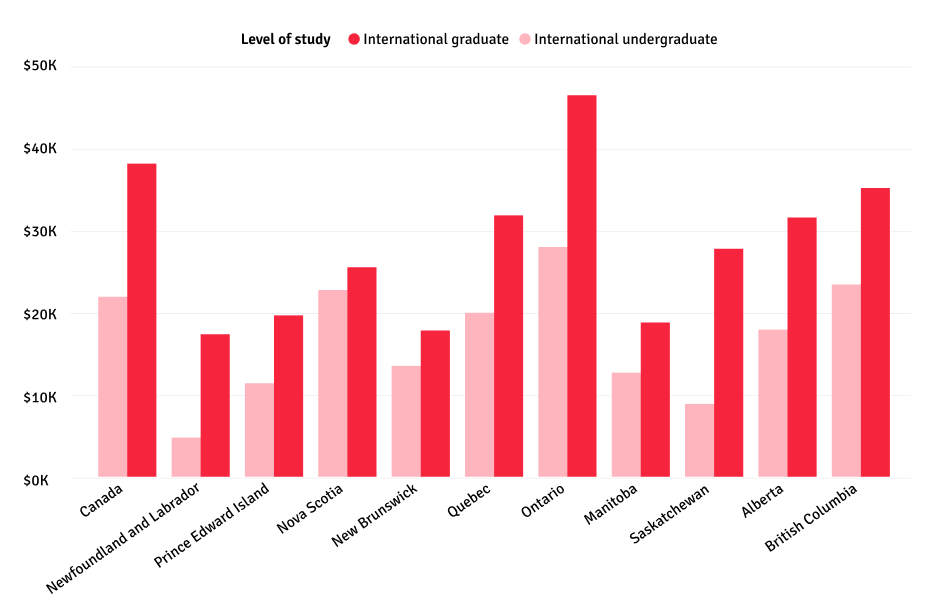
Source: Statistics Canada 2023
Careers
The Canadian Job Bank indicates that the demand for data scientists has substantially exceeded the available talent supply over the last three years, and that this labour shortage is expected to persist through 2031. The increased demand for the job overall makes data science a good bet for future employment in the next decade.
Data science jobs are well compensated, especially as there is currently more demand for this skill set than there are workers. The average annual salary for a data scientist in Canada is $124,693 per year, with related data jobs ranging from $70,676 for data analyst positions, up to $150,186 for machine learning engineers.
Data Analyst – $70,676
Data Analysts are responsible for extracting and analyzing data, as well as putting together data visualizations and dashboards to communicate their insights. They usually focus only on a specific area of data analysis, such as marketing, finance, or operational data, and systematically collect data from databases, reports, and spreadsheets.
Business Analyst – $74,479
Business Analysts assess business processes and devise solutions that improve operational efficiency. Besides analyzing data, they also engage in process modeling and feasibility studies to zero in on possible areas of improvement. Business Analysts are skilled in translating technical concepts into user-friendly language, creating business cases, and overseeing projects to ensure that they’re aligned with organizational strategy.
Business Intelligence Developer – $94,253
Business Intelligence Developers (BI Developers) are responsible for transforming raw data into actionable, data-driven insights. They develop and maintain data warehouses and databases to support reporting, and are also in charge of data cleaning.
Data Engineer – $99,149
Data Engineers are responsible for the end-to-end handling of data for an organization. They collect data from databases and applications to develop data pipelines for data intake, while also taking on data cleaning duties to ensure accuracy and reliability.
Data Scientist – $124,693
Data Scientists automate problem solving through deep learning and pattern recognition, as well as communicate their findings to diverse audiences–making data visualization skills a valuable asset in their toolkit.
Data Architect – $125,977
Data Architects design and maintain data infrastructure within an organization. Ensuring the company’s data systems are organized and accessible is a significant part of their role, as is data security. Architects are responsible for establishing access controls, as well as data protection and encryption protocols, to keep sensitive information secure.
Big Data Engineer – $128,631
Big Data Engineers are responsible for optimizing and managing data infrastructure within an organization. They design and develop data pipelines for storing and collecting massive datasets, and are also responsible for the maintenance of these systems.
Machine Learning Engineer – $150,186
Machine Learning Engineers are responsible for developing, creating, and implementing machine learning algorithms. They contribute to the innovation of new algorithms while improving existing ones, with the primary goal to enhance model accuracy.
Salaries
The average salary for data scientists in Canada is $124,693 based on data collected from Talent.com, Indeed, Glassdoor and Canada’s Job Bank. Here is a closer look at salary ranges based on job type and seniority:
| Role | Average Salary |
|---|---|
| Data Analyst | $70,676 |
| Business Analyst | $74,479 |
| Business Intelligence Developer | $94,253 |
| Data Engineer | $99,149 |
| Data Scientist | $124,693 |
| Data Architect | $125,977 |
| Big Data Engineer | $128,631 |
| Machine Learning Engineer | $150,186 |