
-
 featured
Tuition
$20,025
Scholarships available
-
Online
Oct 20 - Oct 27, 2026
Tuition
$2,395
Scholarships available
-

Tuition
$3,086
Scholarships available
-
Sep 7 - Sep 7, 2028
Tuition
$3,688
Scholarships available
-
Tuition
$10,042
-

Sep 7 - Jan 7, 2029
Tuition
$12,121
Scholarships available
-





About
Behind every hospital bed, virtual-care platform, and community clinic is a web of decisions about people, funding, technology, and policy. Healthcare administration brings those decisions into focus, preparing leaders to improve how care is organized and delivered.
Unlike clinical programs, which train students to diagnose and treat patients, healthcare administration examines the systems surrounding care. Students tackle practical questions facing health leaders: How can hospitals reduce wait times? Where should limited funding go? How can organizations introduce technology while keeping care accessible and patient-centred?
In Canada, one pathway into the field is a Master of Health Administration (MHA), Master of Healthcare Management (MHCM), or related degree from an accredited university. Some programs welcome varied academic backgrounds, while others serve clinicians and healthcare professionals moving into management or executive leadership.
Students may study full or part time, online, in person, or through a hybrid format. Many programs extend beyond the classroom through internships, residencies, consulting assignments, and capstone projects.
Coursework explores the Canadian healthcare system while developing management skills. Students learn to shape strategy, manage budgets, evaluate policy, and more. Programs may also cover health informatics, virtual care, and digital transformation.
Graduates may work in hospitals, primary-care clinics, long-term care, government, public health, consulting, insurance, and health technology, with possible roles ranging from patient care managers to health services directors, policy researchers, healthcare consultants, health information managers, and virtual-care quality leads.
The sector’s job outlook is encouraging, although opportunities vary by role and region. The Canada Job Bank rates the 2025–2027 outlook for healthcare managers as favourable in Ontario, Manitoba, Alberta, and several other regions, and even more favourable in parts of Quebec and Saskatchewan.
FAQ
How can I become a healthcare administrator?
There is no single route into healthcare administration. Some begin with an Honours Bachelor of Health Administration, while many build experience in entry- and mid-level healthcare roles before pursuing a Master of Health Administration, Master of Healthcare Management, MBA, or a related graduate degree. Others work their way into leadership without a graduate degree, advancing through hands-on experience, professional development, and a strong understanding of healthcare operations. While requirements vary by employer and role, combining practical experience with advanced education remains a common and widely respected path.
How long does it take to become a healthcare administrator?
Becoming a junior or mid-level healthcare administrator in Canada can take four to six years of post-secondary education. However, the exact timeline depends on the level of responsibility you are working toward. A four-year Bachelor of Health Administration degree may lead to junior or mid-level roles where professionals build experience in areas such as operations, finance, human resources, health information, or patient services. Some positions may also be accessible through a college credential or by advancing through the health system.
Moving into management or senior leadership typically takes longer—often 10 years or more—since employers typically look for strong professional experience alongside formal education. Many leaders complete an MHA, Master of Healthcare Management, MBA, or related graduate degree to strengthen their expertise in strategy, policy, finance, and organizational change.
What degree is best for healthcare administration?
The best degree for healthcare administration depends on your experience and career goals. A Bachelor of Health Administration can provide a strong foundation for junior and mid-level roles, while a Master of Health Administration (MHA) is often better suited to professionals preparing for management or senior leadership. Unlike a general business degree, an MHA provides specialized training in healthcare leadership, policy, operations, finance, quality improvement, and organizational management—all within the context of a complex, highly regulated health system. An MBA, particularly one with a healthcare focus, can also be a valuable route for professionals seeking broader expertise in business strategy and leadership.
Is getting an MHA difficult?
Getting into an MHA program in Canada can be moderately competitive, but it is generally less difficult than gaining admission to medical school or another clinical graduate program. MHA programs are generally manageable, especially for students with professional experience in healthcare and/or administration.
Are healthcare administrators in demand?
Demand for healthcare leaders varies by role and location but remains positive across much of Canada. From 2025 to 2027, employment growth and retirements are expected to create new opportunities, with the Canada Job Bank rating prospects for healthcare managers as “good” or “very good” in several provinces.
What is the highest paying job in healthcare administration?
The highest paying jobs in healthcare administration are executive C-suite or director-level positions. These roles typically require an MHA or MBA, with a chief executive officer typically earning an average of $145,526 per year and a clinic manager earning an average of $81,464 per year.
Certification
Healthcare administration is not a regulated profession in Canada, which means there is no single licence or certification required to enter the field. Education requirements instead vary by employer and level of responsibility. Many organizations look for a bachelor’s degree in health administration, health sciences, business, or a related discipline, while senior leadership roles may favour candidates with a Master of Health Administration, Master of Healthcare Management, or MBA. Relevant healthcare experience also carries significant weight, particularly for professionals who have advanced through progressively responsible roles.
For those looking to formalize their leadership expertise, the Canadian College of Health Leaders (CCHL) offers the Certified Health Executive (CHE) designation. This voluntary, nationally recognized credential is available to CCHL members who hold a university degree and have at least two years of health-related experience, as well as members without a degree who have accumulated five years of relevant experience. Although the CHE is not required to work in healthcare administration, it can demonstrate a commitment to professional development and may strengthen a candidate’s resumé when it comes to apply for management and executive opportunities.
The Master of Health Care Management (MHCM) at the University of Niagara Falls Canada prepares future leaders to navigate and address the complex challenges facing today’s health care systems. With a strong emphasis on accessibility and equity, the program equips … Continue reading

Dalhousie University’s Master of Health Administration is a CAHME-accredited program designed to prepare transformative leaders who can strengthen healthcare systems and improve health outcomes for communities. The program welcomes students from a wide range of academic and professional backgrounds, including … Continue reading

The Master of Health Administration (Community Care) at the Ted Rogers School of Management, Toronto Metropolitan University, is a pioneering graduate program designed to prepare leaders for the rapidly evolving community care sector. As the first program of its kind … Continue reading

Telfer School of Management’s Master of Health Administration (MHA) is designed to advance the leadership and management capabilities of professionals seeking to make a stronger impact within the Canadian health system. The program blends business, leadership, and healthcare system management … Continue reading

The University of British Columbia’s Master of Health Administration (MHA) is a 24-month professional program designed for clinicians, managers, and researchers seeking to address complex challenges in health system delivery. The program integrates health systems, policy, and management to provide … Continue reading
Telfer School of Management’s Online Executive Master of Health Administration (EMHA) is designed for experienced professionals seeking to advance into senior leadership roles within the healthcare sector. Tailored for individuals with at least five years of managerial or leadership experience, … Continue reading

The University of Toronto’s Master of Health Science in Health Administration (MHSc) is designed to prepare future leaders capable of driving meaningful change within the healthcare sector. The program integrates business, management, and health policy principles to equip students with … Continue reading

The University of Lethbridge’s Master of Health Services Management (MHSM) is a collaborative program offered through the Dhillon School of Business and the Faculty of Health Sciences, designed to prepare working professionals for leadership roles in healthcare management. Delivered in … Continue reading

McGill Desautels Faculty of Management’s International Masters for Health Leadership (IMHL) is a cohort-based Master of Management program designed for experienced healthcare professionals seeking to strengthen their leadership capabilities in a rapidly evolving global healthcare environment. The program combines advanced … Continue reading

The Schulich School of Business Master of Health Industry Administration (MHIA) is a specialized professional degree designed to develop future leaders, managers, and innovators capable of addressing complex challenges in the global healthcare sector. The program integrates business, government, and … Continue reading
Tuition & Completion Data
Domestic

Last updated: October 1, 2026
International
See below for the latest data on international student tuition across Canada, excluding housing costs and ancillary fees.
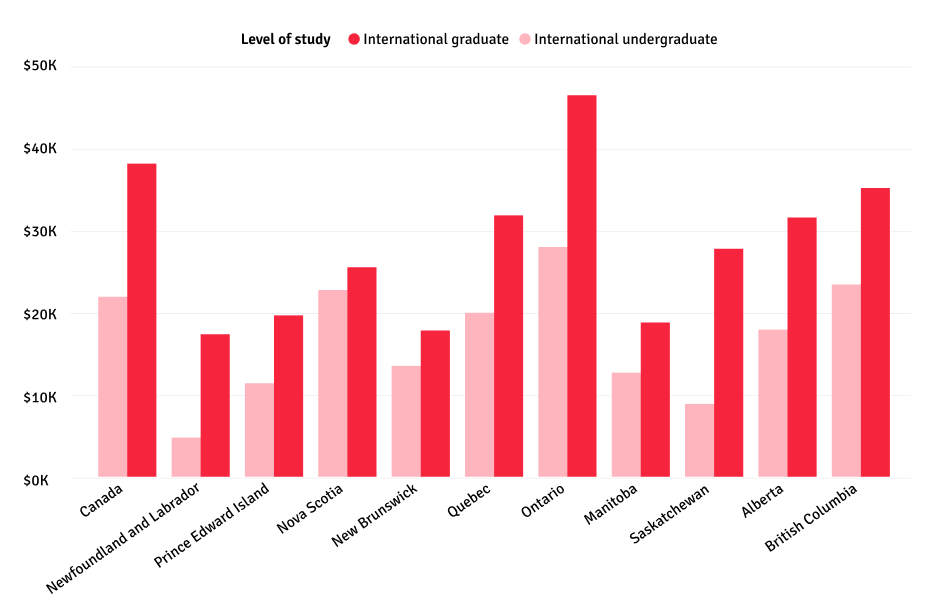
Source: Statistics Canada 2023
Careers
Demand for healthcare leaders remains strong across Canada, driven by sector growth and retirements. The healthcare and social assistance sector added 53,000 jobs between 2024 and 2025, while the Job Bank projects “good” to “very good” prospects for healthcare managers in many regions.
Chief Executive Officer: $145,526
Sets the healthcare organization’s overall direction and oversees its operations, finances, performance, and relationships with its board and stakeholders. This role typically requires a relevant bachelor’s degree, an MHA, or MBA, and extensive senior healthcare leadership experience.
Vice-President: $113,247
Leads a variety of organizational functions such as clinical operations, finance, strategy, or human resources, helping to implement the healthcare organization’s strategic plan. This position typically requires a relevant bachelor’s degree, an MHA, or MBA, and significant healthcare management experience.
Director of Clinical Services: $104,823
Oversees the quality, delivery, staffing, and regulatory compliance of clinical programs and patient services. This role typically requires education and experience in a regulated health profession, active provincial registration where applicable, and several years of clinical leadership experience.
Healthcare Consultant: $88,678
Helps healthcare organizations improve their strategy, operations, policies, technology, finances, or quality of care. This usually requires a relevant bachelor’s degree, and/or an MHA, as well as the relevant healthcare experience.
Clinic Manager: $81,464
Manages a clinic’s daily operations, including scheduling, staffing, budgets, records, patient flow, and regulatory compliance. This typically requires an MHA and healthcare operations experience, with clinical credentials required for some positions.
Salaries
The average salary for a Healthcare Manager in Canada is $109,731 based on data collected from Talent.com, Indeed, Glassdoor, and the Canada Job Bank. But here is a closer look at salary ranges based on job type and seniority:
| Role | Average Salary in Canada |
|---|---|
| Chief Executive Officer | $145,526 |
| Vice-President | $113,247 |
| Director of Clinical Services | $104,823 |
| Healthcare Consultant | $88,678 |
| Clinic Manager | $81,464 |