
Sorry, no courses were found
About

One of the most trusted professions in Canada, firefighters might be as close as we get to real life superheroes, at the forefront of accident prevention and emergency responses across the country alongside paramedics and police officers. Whether they’re extinguishing fires, rescuing people from accident sites, providing emergency medical care, or communicating with the public about fire safety, firefighters are critical to the safety and wellbeing of our communities.
To tackle emergencies, firefighters must be able to keep a clear head in high-stress environments, with excellent problem-solving skills, effective communication, and strong spatial awareness. These skills can be developed through firefighter training courses at public colleges and private institutions throughout the country, which provide proper certification and real-world practice.
Some provinces – for example, Ontario, Quebec, and Manitoba – require specific certificates to work as a firefighter. In other provinces, such as Prince Edward Island, New Brunswick, Saskatchewan, certification is voluntary. However, aspiring firefighters must typically hold a high school degree and be able to pass a physical fitness assessment, including a vision test.
There are a plethora of career options to explore in the fire safety industry; where municipal firefighters work for a city or town, wildland firefighters control fires in forests and rural communities. Specialized training can unlock other fire safety roles: for example, fire inspectors ensure buildings comply with fire code, while fire protection engineers design fire safety systems for buildings.
In 2024, the Canadian Association of Fire Chiefs reported that, of the 123,000+ firefighters in Canada, just over 87,000 were volunteers. Volunteer firefighters are part-time, often working jobs outside of their firefighting role. In Canada, volunteer firefighters typically do not receive a salary — however, they may receive hourly compensation, and be eligible for a specific tax credit, as CBC reports.
The average wildland firefighter will earn around $66,000 annually, while urban firefighters (sometimes referred to as structural firefighters) tend to have higher salaries, closer to $85,000 a year. More specialized roles that have additional education requirements, like fire protection engineer, as well as more senior leadership positions like fire chief, will earn average salaries between $104,000 and $160,000.
Frequently Asked Questions (FAQ)
What qualifications do I need to work as a firefighter in Canada?
Each province has different expectations for prospective firefighters. Certification is required in Nova Scotia, Quebec, Ontario, Manitoba and Alberta. For example, in Calgary, a qualified firefighting candidate must have completed an Advanced First Aid (AFA) course (or a minimum 80-hour equivalent), teaching advanced first aid techniques to first responders. They must also hold a CPR Health Care Provider designation, or a Basic Life Support designation, on top of a driver’s licence with an Air Brake Q endorsement.
In Newfoundland and Labrador, Prince Edward Island, New Brunswick, Saskatchewan, British Columbia, the Yukon, the Northwest Territories and Nunavut, certification is voluntary. However, candidates are typically expected to hold a high school diploma, to meet specific strength, agility, and vision requirements, and to have a clean police record check that shows they can work with vulnerable sectors.
How long does it take to become a firefighter?
Across Canada, firefighters must be at least 18 years of age, hold a high school diploma and a driver’s licence. At public colleges, a typical firefighting certification can take up to a year to complete, while some private institutions offer training and certification in as little as 12 to 24 weeks.
Firefighting can be a competitive field; candidates sometimes have to apply for a position multiple times, and employers looking to hire full-time firefighters may require applicants to have three to five years of experience in the field.
While waiting to be accepted for a full-time, salaried position, candidates might work as a volunteer firefighter, building experience that is attractive to potential employers.
How long are firefighter shifts in Canada?
Fire departments across the country structure their shifts differently, but the 24-hour shift is increasingly popular, with fire departments citing increased productivity on the job, as well as enhanced work-life balance for employees.
In many provinces throughout Canada, firefighters are required to work 24-hour shifts, as well as being on-call during weekends and holidays. For example, in Richmond, British Columbia, firefighters work for 24 hours, are off for 24 hours, are then on again for 24 hours, before being off for five days.
Other options include shorter, rotating shifts, like in Winnipeg, Manitoba, which currently assigns two-day shifts of 10 hours, two night shifts of 14 hours, and four days off. However, the province is also considering moving towards the 24-hour shift rotation, supporting employee’s work-life balance, and overall cost-savings for the department.
What does the salary for a firefighter look like?
According to Indeed, Glassdoor, and Talent.com, the average salary for a firefighter can depend on where exactly they’re fighting fires. A typical wildland firefighter will earn around $66,000 annually, while urban firefighters (also referred to as structural firefighters) tend to have higher salaries, closer to $85,000 a year.
Then, there are more specialized roles that have additional education requirements, like fire protection engineer, as well as more senior leadership positions like fire chief, which will earn higher average salaries, between $104,000 and $160,000.
Certification
A physically-demanding job only suited for applicants in top shape, standard requirements for firefighter candidates include that they:
- Hold a Grade 12 diploma and drivers’ licence
- Obtain a first-aid certificate for emergency medical care
- Pass a fitness assessment
- Have proof of immunizations (for example, Hepatitis B and influenza)
- Have no criminal convictions
Whether or not an official firefighter training certification is mandatory varies by province. According to Canada’s Job Bank, certification is required to work as a firefighter in Nova Scotia, Quebec, Ontario, Manitoba, and Alberta (though some requirements do vary city to city, even within provinces); certification is voluntary in Newfoundland and Labrador, Prince Edward Island, New Brunswick, Saskatchewan, British Columbia, Yukon, the Northwest Territories, and Nunavut.
For provinces where firefighting training certification is required, the most common license is the National Fire Protection Association (NFPA) 1001 standard – including Firefighter I and II – covering both career and volunteer firefighters, where duties are mostly structural. (In Ontario, most institutions offer a Pre-Service Firefighter Education and Training program designed to meet the requirements for NFPA 1001 Firefighter I and II.)
NFPA’s Fire Fighting Level I covers:
- Health and safety
- Personal protective equipment, as well as firefighter tools and equipment
- Fire service communications
- Search and rescue, forcible entry, and more.
NFPA’s Fire Fighting Level II covers:
- Establishing and transferring command
- Advanced fire suppression
- Identifying the cause of a fire
- Vehicle rescue and extrication operations, and more.
NFPA’s Fire Fighting Level I and Level II courses are delivered as a mix of in-class and on-site learning. Offered by accredited institutions across Canada, the course can take between 20 days to 18 weeks to complete, depending on the school. Course prices can range between $8,800 to $16,600.
Course packages may also include the NFPA 1072 Hazmat Awareness & Hazmat Operations certificate, which is often required by employers. This certificate covers:
- Identifying the presence of hazardous materials and understanding their properties
- Health and safety responses
- Personal protective equipment
- Regulations, standards and laws around handling hazardous materials
While different fire departments will have their own requirements, the above three certificates are commonly required for an entry-level position.
Certain firefighting roles, such as a fire protection engineer, can require additional education, such as a Fire Safety Engineering Technician or Technology diploma, typically two or three years in duration. Additional certifications help firefighters specialize as they grow more experienced, and potentially explore roles with less emphasis on emergency response in the field. First responders can also explore trauma recovery training certificates to help them manage the toll of the sometimes-difficult nature of their job.

Southwest Fire Academy offers an intensive, blended Firefighter Pre-Service training program that combines self-directed online learning with a 20-day immersive bootcamp designed to deliver a true, real-world firefighter experience. The majority of theoretical learning is completed independently through structured online … Continue reading
Tuition
$8,795


Tuition
$8,795

Students who enroll in Centennial College’s Firefighter – Pre-Service Education and Training program will learn the fundamental skills required for a career in fire fighting, making them a eligible candidate for future employment in the fire industry. By combining theory … Continue reading
Tuition
$12,170
Scholarships available
Tuition
$12,170
Scholarships available

This 85-day program immerses students in the realities of firefighting, with training delivered at a cutting-edge facility and fire ground. Students learn from the same professional fire instructors who train active firefighters, alongside an extensive network of over 80 experienced … Continue reading
Tuition
$16,630
Tuition
$16,630

Humber’s Fire Services diploma program provides students with a strong foundation in fire science, fire prevention, safety, and the physical and mental health aspects of the profession. Students learn in a collaborative environment, gaining the knowledge, skills, and abilities required … Continue reading

For those with a passion for firefighting and fire protection, this two-year diploma program lays the foundation for a dynamic career in the fire service or as a fire protection engineering technician. Students will build a strong knowledge base in … Continue reading

When you’re ready to step into the world of emergency response, Lakeland’s Emergency Services Technology (EST) program is a great launchpad. This one-of-a-kind, full-time diploma blends firefighting and pre-hospital care, making it the only program of its kind in Canada. … Continue reading

Immersed in a dynamic and challenging learning environment, students develop the skills required to perform the duties of a firefighter. Through a combination of theoretical instruction and hands-on training, students gain knowledge in fire dynamics, building construction, fire suppression principles, … Continue reading
Tuition & Completion Data
Domestic

Last updated: April 1, 2026
International
See below for the latest data on international student tuition across Canada, excluding housing costs and ancillary fees.
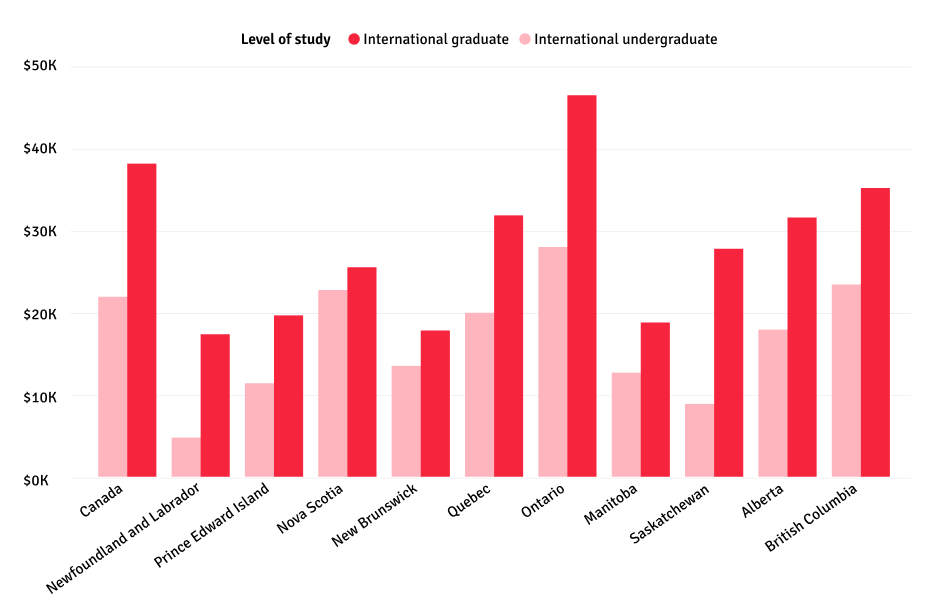
Source: Statistics Canada 2023
Careers
There is always a need for first responders, and firefighters are no exception. According to the Canadian Occupational Projections System, the job market for firefighters will be balanced for the next decade, with a total of 15,900 new job openings between 2024-2033.
Below are some of the career paths that an aspiring firefighter can take, with salary ranges reflecting varied earnings based on geography and seniority.
Emergency Dispatcher – $38,000 – $73,000
Taking emergency calls from the public, emergency dispatchers (or fire dispatchers) must be able to quickly assess the caller’s situation, identify vital information, and calmly follow procedures to dispatch firefighting services as required.
Fire Inspector – $45,000 – $82,000
Fire inspectors, sometimes known as fire sprinkler inspectors, are tasked with proactively protecting people and buildings by conducting regular inspections of buildings, ensuring they comply with fire safety codes, and consulting with landowners and building designers to recommend fire safety measures, such as sprinklers, fire exits, and more.
Wildland Firefighter – $40,000 – $85,000
Often working in extreme conditions, wildland firefighters protect natural landscapes like forests and rural areas by monitoring and combating fire; methods include aerial support, using helicopters to drop water and flame-resistant materials on fires, starting controlled burns to maintain a larger fire, and more.
Structural Firefighter – $69,000 – $104,000
Typically, when we imagine a firefighter – with red helmets and oxygen tanks strapped to their back, heading toward a burning building – it’s a structural firefighter that we’re thinking of. Unlike wildland firefighters, structural firefighters often work in urban settings, extinguishing fires from family homes to industrial facilities.
Aircraft Rescue Firefighter – $68,000 – $110,000
Also referred to as airport firefighters, aircraft rescue firefighters respond to aircraft emergencies, providing fire suppression services, mitigating any chemical hazards like fuel spills, and providing emergency medical care like CPR as required.
Fire Marshal – $68,000 – $110,000
With great attention to detail and strong leadership skills, fire marshals identify the cause of fires, inspect buildings to ensure they are in line with fire code, and educate the public on fire safety. They often report to government bodies, and collaborate closely with law enforcement.
Fire Investigator – $70,000 – $110,000
Using fire investigation methodology, these professionals assess a fire scene to identify what caused a fire, gathering and preserving evidence as required. They also consult with homes, offices and businesses to advise on fire safety measures and ensure compliance with fire safety codes.
Firefighter / Paramedic – $72,000 – $110,000
A firefighter paramedic (also referred to as a firefighter medic or firefighter EMT) responds to and extinguishes fires, as well as medical emergencies. With strong teamwork skills, they provide emergency medical care like CPR, and treat on-site injuries while awaiting the arrival of more advanced medical personnel. Other duties can also include transporting patients to hospital
Fire Protection Engineer – $80,000 – $128,000
Often requiring a diploma or degree in fire safety engineering, with additional certification as required, fire protection engineers leverage their scientific expertise to protect buildings – and the people in those buildings – from fire hazards, by designing fire detection and suppression systems. This can include things like water sprinklers, fire extinguishers and more.
Deputy Fire Chief – $104,000 – $150,000
Reporting to the fire chief, a deputy fire chief is responsible for the day-to-day operations of a fire department; they manage staff, develop policies for fire prevention, and coordinate fire safety measures with local institutions.
Not all departments have deputy chiefs; smaller fire departments may only have one fire chief, which explains why the average pay between the two roles are so similar – departments large enough to employ a deputy as well tend to have more funding, and pay more.
Fire Chief – $104,000 – $160,000
As the head of fire departments, fire chiefs manage the operations of their organization; as leadership, they direct personnel during emergencies, plan, organize and direct firefighting operations, and manage departmental budgets. Fire chiefs may also be required to act as a spokesperson, liaising with the government, public and media.
Salaries
The average salary for a structural firefighter in Canada is between $69,000 – $104,000, based on data collected from Talent.com, Indeed, and Glassdoor. Here is a closer look at salary ranges based on job type and seniority:
| Role | Average Salary in Canada |
|---|---|
| Emergency Dispatcher | $56,349 |
| Fire Inspector | $60,724 |
| Wildland Firefighter | $66,869 |
| Structural Firefighter | $84,603 |
| Fire Marshal | $86,698 |
| Aircraft Rescue Firefighter | $86,772 |
| Firefighter / Paramedic | $87,529 |
| Fire Investigator | $90,000 |
| Fire Protection Engineer | $108,903 |
| Deputy Fire Chief | $124,268 |
| Fire Chief | $125,000 |